



Ukraine strikes Ozon logistics hubs as drone campaign widens in Russia
Ukrainian drones targeted Ozon logistics sites across southern Russia, causing fires, evacuations and market losses as Kyiv expands attacks on supply networks.


By Ahmet Taş | Wise News Press
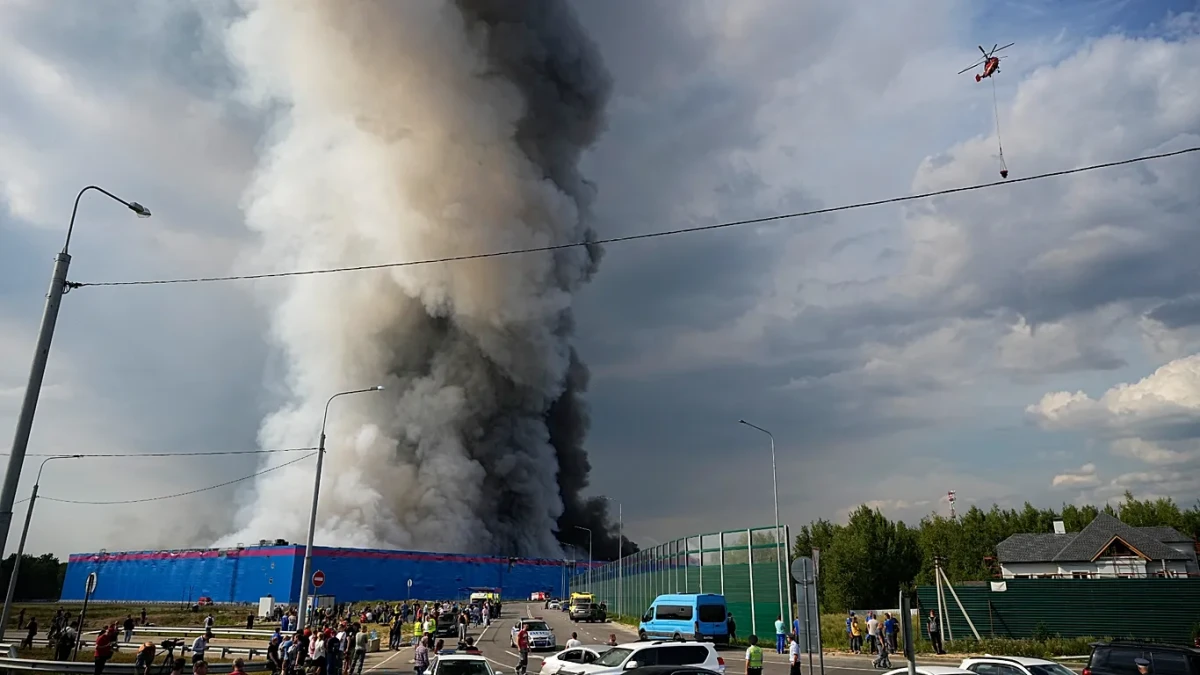
MOSCOW, RUSSIA — Ukrainian drones targeted Ozon logistics facilities across southern Russia on Monday, setting two major sites on fire and forcing evacuations as Kyiv widened its campaign against supply networks it says support Moscow’s military.
Russia’s second-largest online retailer said facilities in Makhachkala and Enem were hit, while warehouses in Adygeysk and Nevinnomyssk were evacuated because of drone threats. The latest incidents brought the number of Ozon facilities targeted since August 22 to six, after earlier strikes in the Samara and Orenburg regions.
The campaign follows weeks of Ukrainian strikes against Ozon rival Wildberries and marks a notable expansion of Kyiv’s long-range operations from traditional military and energy targets toward large commercial logistics networks that Ukraine describes as part of Russia’s dual-use wartime supply system. Russia rejects that characterization and says the facilities are civilian infrastructure.
Fire and injuries reported at Makhachkala logistics hub
Ozon said a drone struck its logistics center in Makhachkala, the capital of Dagestan, at around 05:00 local time.
A fire broke out at the facility, several people were injured and operations were suspended while emergency crews responded.


The company said employees were rapidly evacuated and that the injuries were not believed to be life-threatening.
A second major fire was reported at an Ozon logistics facility in Enem, near Krasnodar.
Ozon said workers were evacuated from the site and no casualties were reported there.


Facilities in Adygeysk, in the Republic of Adygeya, and Nevinnomyssk, in Stavropol Krai, were also evacuated overnight because of the threat of drone attacks. Ozon said those two sites and the goods stored inside them were not damaged.
The distinction is important: although four Ozon hubs were affected by Monday’s drone alert and attack wave, confirmed physical damage was reported at Makhachkala and Enem, while the other two locations were closed preventively.
Six Ozon facilities targeted since August 22
The latest attacks came only two days after Ozon entered Ukraine’s expanding logistics campaign.
A company warehouse in Russia’s Samara region was hit on August 22, disrupting operations and forcing workers to evacuate. Another Ozon facility in the Orenburg region was also targeted during the weekend attacks.
Monday’s incidents therefore raised the number of Ozon facilities affected or targeted since Saturday to six.
Ozon is one of Russia’s largest digital marketplaces and operates a nationwide network of fulfillment centers that receive, store, sort and dispatch enormous volumes of consumer goods.
The size and geographic reach of those networks also make them important elements of Russia’s wider commercial transportation system.
For Kyiv, that is precisely what makes the facilities strategically relevant.
Ukraine says commercial warehouses support military supply chains
Ukraine’s Ministry of Defence has argued that major Russian online marketplaces are not purely civilian retail networks because their warehouses contain dual-use products — goods that may have civilian applications but can also be used by military units.
Kyiv says the logistics infrastructure supporting the distribution of those products therefore contributes to Russia’s war effort.
The Ozon campaign follows a much broader series of attacks on Wildberries, Russia’s largest online retailer.
Ukraine’s Defence Ministry said earlier this month that seven of Wildberries’ 10 largest logistics centers had been knocked out of operation during strikes since July. One of the targets was the company’s approximately 250,000-square-meter Koledino logistics hub in the Moscow region.
Ukraine publicly framed the move toward Ozon as the next stage of that campaign.
The strategy appears designed not only to destroy individual warehouses but also to force Russian companies to reroute deliveries, disperse stock, increase insurance and security costs and reorganize logistics networks.
Russia says Ozon warehouses are civilian infrastructure
Moscow disputes Ukraine’s justification.
Russian authorities have condemned attacks on commercial warehouses and describe the targeted facilities as civilian infrastructure.
That disagreement is central to the controversy surrounding the campaign.
Large e-commerce warehouses primarily serve civilian customers. Ukraine, however, argues that some facilities also store or distribute goods with potential military uses.
Publicly available information does not establish that every Ozon facility targeted in the campaign was directly being used for military logistics at the time of attack.
The distinction matters because a civilian facility does not automatically lose its protected status merely because some of the products it handles could have military applications.
At the same time, modern wars increasingly depend on civilian transportation, communications and commercial distribution systems, making the boundary between civilian and military logistics more contested.
Ozon shares fall as attacks reach investors
The strikes immediately affected financial markets.
Reuters reported that Ozon shares fell by as much as 12% on the Moscow Exchange following news of Monday’s attacks.
Shares in AFK Sistema, a major Ozon shareholder, fell by almost 13%.
The decline illustrates how Ukraine’s long-range strike campaign is beginning to generate consequences beyond damaged buildings.
Even when a warehouse is not completely destroyed, repeated drone alerts can interrupt shifts, force evacuations, delay deliveries and require companies to redesign transport routes.
For an e-commerce company built around high-speed fulfillment, those disruptions can translate rapidly into additional costs and investor uncertainty.
The strikes also come as Russian businesses face broader economic pressure from the continuing war and Western sanctions.
From refineries to warehouses: Kyiv broadens economic pressure
Ukraine has spent much of the war developing longer-range domestically produced drones capable of reaching targets hundreds or even more than 1,000 kilometers inside Russia.
Oil refineries, fuel depots, military factories and air bases have been among the most prominent targets.
The recent campaign against Wildberries and Ozon suggests another layer is being added: large logistics and distribution nodes.
An Associated Press report on Ukrainian long-range drone units described Kyiv’s strategy as an effort to damage not only Russia’s military-industrial infrastructure but also the economic systems that allow the war to continue deep behind the front.
That creates a different type of pressure.
Destroying a refinery directly affects fuel production.
Striking a major fulfillment center can disrupt thousands of suppliers, sellers, delivery routes and customers simultaneously.
The military value of individual commercial sites may remain disputed, but the economic effect of repeated attacks on centralized logistics networks can extend well beyond the warehouse itself.
Ozon campaign signals a new phase in Russia’s logistics war
The events of August 24 show how rapidly Ukraine’s strike strategy is evolving.
Makhachkala and Enem suffered fires.
Adygeysk and Nevinnomyssk stopped operations during drone threats.
Samara and Orenburg had already been targeted over the weekend.
And the attacks came immediately after a sustained Ukrainian campaign against Wildberries’ largest distribution centers.
For Ozon, the immediate challenge is restoring damaged facilities and maintaining deliveries across a network increasingly exposed to long-range drone attacks.
For Russia, the broader problem is the growing number of categories of infrastructure that must now be protected far from the Ukrainian border.
And for Ukraine, the campaign represents an attempt to make the economic and logistical consequences of the war increasingly visible inside Russia.
Whether attacks on commercial e-commerce networks can meaningfully weaken Russian military supply remains difficult to quantify.
But one effect is already clear: the battlefield is expanding from trenches, refineries and arms factories into the logistics networks that keep Russia’s wider economy moving.
WiseNewsPress.com
What's Your Reaction?
 Like
0
Like
0
 Dislike
0
Dislike
0
 Love
0
Love
0
 Funny
0
Funny
0
 Wow
0
Wow
0
 Sad
0
Sad
0
 Angry
0
Angry
0

Ahmet Taş is a journalist, editor and Turkey Office Manager of the Wise News Press Media Group. He works across news, digital media and international publishing, focusing on accurate, responsible and accessible journalism. He contributes to the development of media projects that bring important political, social and global developments to a wider international audience.




















Comments (0)