



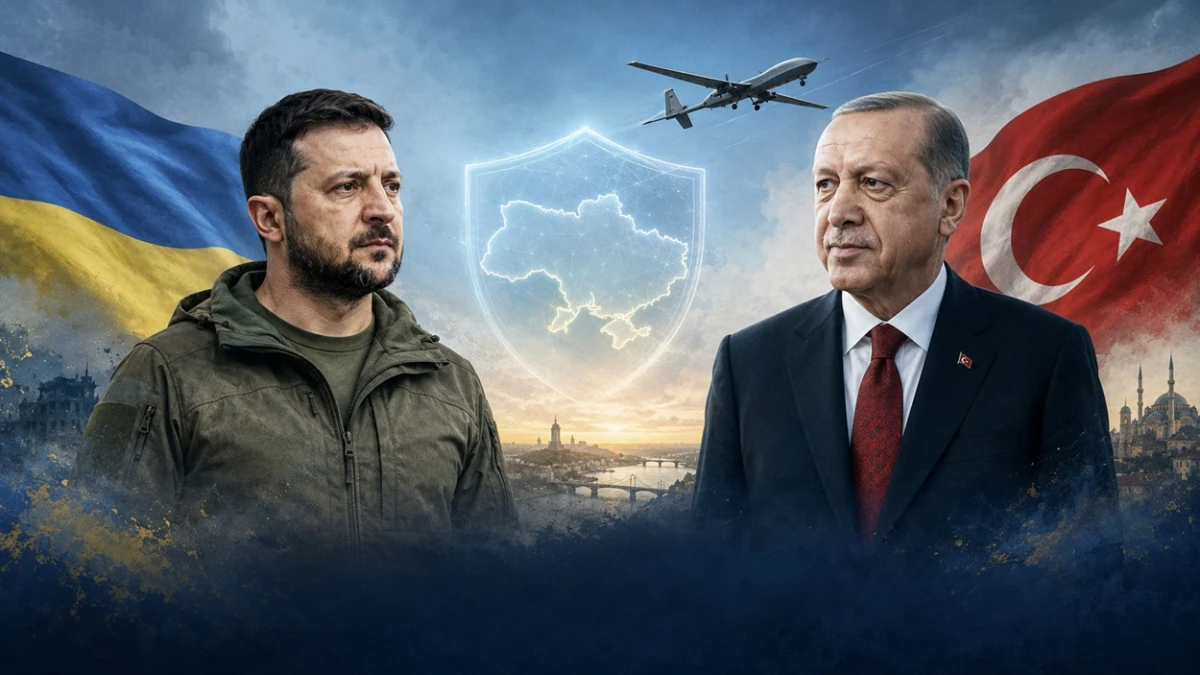
Zelensky, Erdoğan and Bayraktar: The strategic shield around Ukraine
Zelensky’s wartime diplomacy and Türkiye’s early support helped Ukraine endure Russia’s invasion; that strategic friendship must now reach everyday institutions.


By Yusuf İnan | Wise News Press
Journalist and Author | Political and Strategic Analyst
Russia’s full-scale invasion forced Ukraine to fight on two fronts at once: one against Russian forces on the battlefield, and another for political, military and public support across the world. Volodymyr Zelensky proved unusually effective on that second front.
Ukraine’s survival cannot be attributed to one man. Its soldiers, civilians, state institutions, intelligence services and international partners have all carried enormous weight. Yet Zelensky’s role in turning Ukraine’s resistance into an international cause is difficult to dispute.
His achievement was not simply to ask foreign governments for weapons.


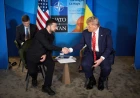
He built what can be described as a strategic shield of friendly countries around Ukraine — a network of governments willing to provide weapons, intelligence, economic assistance, diplomatic backing and political legitimacy at a moment when Moscow expected Kyiv to be isolated.
Zelensky turned an unconventional background into wartime strength
Before entering politics, Zelensky was an actor, producer and media entrepreneur.
For a traditional political establishment, that background could easily have been portrayed as a weakness. During wartime, however, it became one of his greatest strategic advantages.


An actor understands the camera.
A producer understands narrative.
A communicator understands that the same message cannot always be delivered in exactly the same way to every audience.
Zelensky used all three skills.
He spoke to parliaments across Europe and North America, adapting Ukraine’s message to the historical experiences and political culture of each country. He communicated directly through videos rather than relying entirely on traditional diplomatic channels. He made Ukraine’s survival understandable not only as a Ukrainian national interest but as a struggle over sovereignty, borders and the principle that stronger states cannot simply absorb weaker neighbours by force.
That ability mattered because modern war is not fought only with artillery.
It is also fought over attention, legitimacy and political endurance.
Without sustained Western public and political support, weapons deliveries could have slowed, sanctions could have weakened and Ukraine could have gradually disappeared from the centre of the international agenda.
Zelensky refused to let that happen.
The former actor disrupted the Kremlin’s assumptions
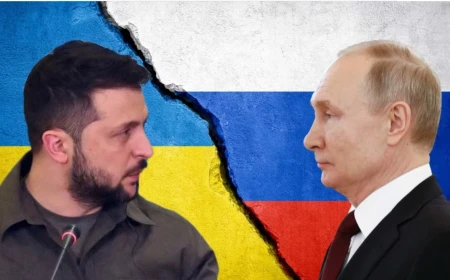
Russian President Vladimir Putin appears to have seriously underestimated both Ukraine and Zelensky.
The Kremlin expected a rapid military breakthrough, political collapse in Kyiv and a divided international response.
None of those assumptions fully materialised.
Zelensky remained in the capital. Ukraine’s state institutions continued functioning. The armed forces resisted. Foreign governments progressively increased military and financial assistance.
For that reason, it would be rhetorically powerful but strategically inaccurate to say that Zelensky “brought Putin to his knees.” Russia still occupies Ukrainian territory and the war continues.
The more important achievement is this:
The politician Putin underestimated helped destroy the Kremlin’s expectation of a quick victory and an isolated Ukraine.
Instead of confronting a politically abandoned state, Russia found itself fighting a country backed by a broad international coalition.
That is one of Zelensky’s most important contributions to modern political leadership.
He demonstrated that a medium-sized country facing a much larger military power can compensate for some of its material weaknesses through strategic communication, alliance-building and international legitimacy.
Türkiye was part of Ukraine’s defensive architecture before 2022
Türkiye occupies a special place in this story.
Its contribution did not begin on February 24, 2022.
Ukrainian-Turkish defence cooperation was already developing before the full-scale invasion. Bayraktar TB2 drones had entered Ukrainian service, and cooperation with Baykar was expanding in training, maintenance and defence-industrial projects.
That early preparation became particularly important when the invasion began.
Türkiye also maintained a clear position on one of Ukraine’s most fundamental territorial issues: Ankara did not recognise Russia’s annexation of Crimea.
When the full-scale war started, Türkiye condemned the Russian attack, reaffirmed Ukraine’s territorial integrity and later implemented the wartime provisions of the Montreux Convention governing access to the Turkish Straits.
That decision had strategic importance in the Black Sea.
At the same time, Ankara maintained diplomatic communication with Moscow — a balancing act that allowed Türkiye to support Ukraine while remaining one of the few NATO states able to speak directly with both belligerents.
That capacity later contributed to negotiations over grain exports, prisoner exchanges and other diplomatic initiatives.
Bayraktar became more than a weapons platform
In the first phase of the invasion, the Bayraktar TB2 became one of the symbols of Ukrainian resistance.
Its military value has sometimes been exaggerated in popular discussion, particularly as Russian air defences adapted over time. But its political and psychological impact during the early stage of the war was substantial.
The aircraft represented something larger than a single weapons system.
It represented preparation before the invasion, technological cooperation between Türkiye and Ukraine and the willingness of a Turkish company to remain visibly associated with Ukraine when the outcome of the war was still uncertain.
Baykar later provided drones to Ukraine without payment after fundraising campaigns had collected money to purchase them.
Selçuk Bayraktar and Baykar therefore became part of Ukraine’s wartime public memory.
This contribution should neither be romanticised nor forgotten.
Türkiye is a state and naturally acts according to its own national interests — Black Sea security, defence industry development, regional influence, trade and the Crimean Tatar question among them.
Yet strategic interest and principled policy are not mutually exclusive.
Türkiye took positions that carried real political risk at a time when the future direction of the war was still unclear.
The next frontier could be AI-enabled defensive technology
Türkiye and Ukraine now possess highly complementary experience.
Ukraine has accumulated battlefield knowledge on drones, electronic warfare, air defence, targeting, logistics and adaptation under extreme pressure.
Türkiye has developed a major defence-industrial ecosystem around unmanned aircraft, precision weapons, electronics and increasingly sophisticated autonomous systems.
The logical next step is deeper cooperation in AI-assisted but human-controlled defence technology.
That could include autonomous navigation, anti-drone systems, electronic-warfare-resistant communications, machine vision, maritime unmanned systems and defensive AI tools capable of protecting countries that lack large conventional militaries.
The emphasis on human control is essential.
The future should not simply be about developing machines that can kill without accountability. The strategic opportunity is to use artificial intelligence to improve detection, navigation, survivability and defensive effectiveness while maintaining meaningful human responsibility over lethal decisions.
A Türkiye-Ukraine technology partnership in this field could become one of the most important security collaborations around the Black Sea.
But friendship between states must also be visible in bureaucracy
There is another side to strategic partnership that receives far less attention.
Friendship cannot exist only between presidents, defence ministers and major companies.
It must also be visible at the level of ordinary public institutions.
Turkish citizens living in or travelling through Ukraine should not expect special privileges because Türkiye supports Ukraine.
But they should expect legality, equal treatment, respect, transparent procedures and administrative seriousness.
When foreign residents encounter unexplained delays, arbitrary decisions, institutional indifference or situations in which one government body simply transfers responsibility to another, the damage extends beyond an individual bureaucratic dispute.
It affects trust.
And when those problems concern citizens of a country that Ukraine repeatedly describes as a strategic partner, they can gradually erode the social foundations of that partnership.
Reciprocity does not mean preferential treatment.
It means that strategic friendship should produce an especially strong commitment to ensuring that neither country’s citizens are treated as second-class people by the other’s institutions.
Ukraine must not lose in its bureaucracy what its soldiers win at the front
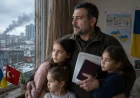
The human cost of this war is visible across Ukraine.
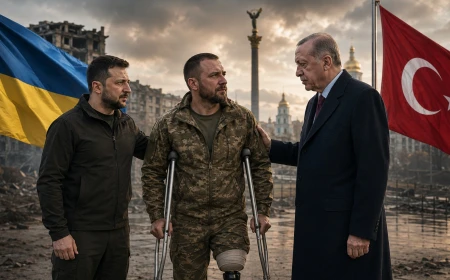
Young soldiers who have lost arms or legs can be seen moving through Ukrainian cities with prosthetics or crutches.
Families have buried sons, daughters, fathers and mothers.
Soldiers continue to fight after years of exhaustion because they believe that Ukraine’s independence is worth defending.
Their sacrifice represents more than territorial survival.
It represents the claim that law is stronger than brute force.
That principle must also be defended inside the state.
If soldiers fight arbitrary Russian power at the front while citizens or foreigners encounter arbitrary administration behind the lines, Ukraine risks creating a contradiction between the ideals it defends internationally and the reality experienced inside its institutions.
Corruption, bureaucratic abuse, local patronage networks and institutional irresponsibility are therefore not merely domestic administrative problems.
They are national-security vulnerabilities.
Every scandal that suggests Ukraine cannot protect property rights, treat foreigners fairly or enforce its own laws can be exploited by Russian propaganda.
Moscow does not need to invent every story.
Sometimes dysfunctional bureaucracy creates the material for propaganda itself.
Zelensky’s second historic test is the state he leaves behind
Zelensky’s first great test began on February 24, 2022.
Would he stay?
Would the government function?
Could Ukraine persuade the democratic world that its survival mattered?
On those questions, his leadership changed the course of the war.
His second great test is different.
Can Ukraine transform wartime sacrifice into a stronger state?
Can it create institutions worthy of the soldiers who defended them?
Can a citizen, a foreign resident or an investor enter a police station, migration office, municipality or court and encounter rules rather than personal discretion?
Can Ukraine build a state that treats its friends with the same respect it asks its friends to show Ukraine?
These questions will ultimately shape Zelensky’s historical legacy as much as his wartime speeches.
Türkiye’s contribution should also be understood in that larger frame.
President Recep Tayyip Erdoğan’s consistent refusal to recognise Russia’s annexation of Crimea, Türkiye’s wartime diplomacy, its implementation of Montreux and the contribution of Bayraktar technology all belong to the history of Ukraine’s resistance.
Ukraine has repeatedly acknowledged that support.
The next step should be to turn strategic friendship into institutional trust.
The strongest Ukraine-Türkiye relationship would therefore rest on four pillars:
defence cooperation, diplomatic solidarity, technological partnership and mutual respect within state institutions.
That would be more than gratitude for past assistance.
It could become part of a new Black Sea security architecture capable of protecting both countries — and perhaps other nations that one day find themselves facing a stronger aggressor.
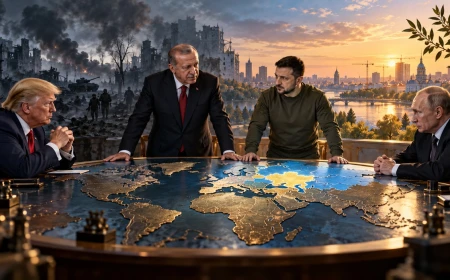
Zelensky helped persuade the world not to abandon Ukraine.
Erdoğan and Türkiye were among the actors that stood with Kyiv when the outcome was far from certain.
Bayraktar became one of the symbols of that early resistance.
Now Ukraine faces the harder long-term challenge:
to ensure that the state defended with extraordinary sacrifice becomes as strong, fair and trustworthy inside its institutions as it has proved resilient on the battlefield.
Yusuf İnan
WiseNewsPress.com
Yusuf İnan is a journalist, author, and political and strategic analyst. He serves as editor-in-chief of UAPresa.com, WiseNewsPress.com, SehitlerOlmez.com, SiyasetinSesi.com and YerelGundem.com. His work focuses on strategic and political analysis concerning developments in Türkiye and around the world.
What's Your Reaction?
 Like
0
Like
0
 Dislike
0
Dislike
0
 Love
0
Love
0
 Funny
0
Funny
0
 Wow
0
Wow
0
 Sad
0
Sad
0
 Angry
0
Angry
0
Yusuf İnan is a journalist, columnist, strategic analyst and head of the Wise News Press Media Group. His work focuses on international affairs, geopolitics, security and major social issues. Through his journalism, he promotes peace, dialogue, mutual understanding and responsible reporting while contributing to the development of international media projects.











Comments (0)