



War Day 3: US and Israel Bomb Tehran; Casualties Rise to 555
On the third day of the conflict, U.S. and Israeli forces intensified their bombardment of Tehran as Iranian casualties reached 555 and energy production across the Gulf ground to a halt.


BY AHMET TAŞ | WISE NEWS PRESS
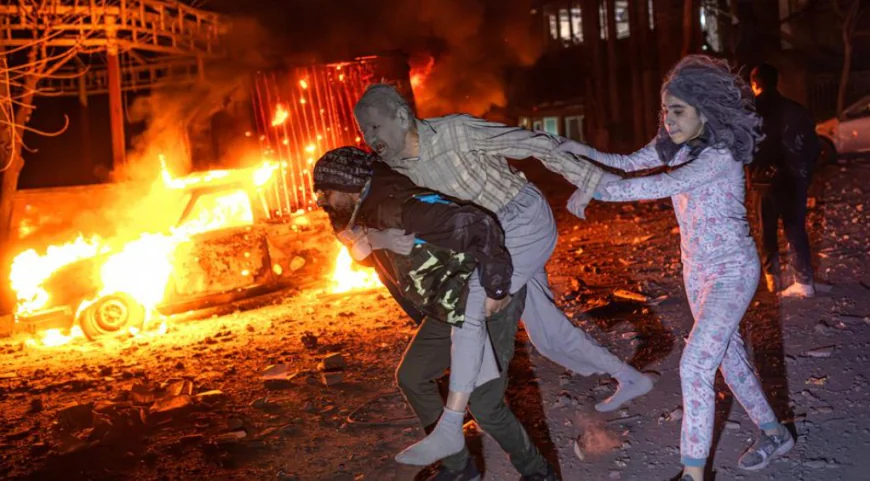
TEHRAN, IRAN — The military confrontation between U.S.-led forces and Iran entered its third day on Monday with intensified aerial bombardments of Tehran, resulting in a rapidly mounting death toll and a total suspension of liquefied natural gas (LNG) and oil production across several Gulf nations.
According to reports from the Iranian Red Crescent, at least 555 people have been killed and 747 others injured as strikes targeted over 130 settlements across the country. The conflict has now expanded beyond Iranian borders, sparking retaliatory strikes in Lebanon and a drone attack on a British military base in Cyprus, while global markets reel from the sudden shutdown of critical energy exports from Qatar and Saudi Arabia.
Devastating Toll in Tehran and Broadening Frontiers
The bombardment of the Iranian capital has been described as relentless, with local news outlets reporting that sivil infrastructure, including police stations in public squares like Nilüfer Square, has been hit. The semi-official Fars News Agency indicated that search and rescue operations involving over 100,000 personnel are currently underway nationwide to recover victims from the rubble.
In a significant diplomatic dispute, Iranian officials claimed that the Natanz nuclear facility was hit, resulting in the total destruction of one uranium enrichment plant and severe damage to another. However, Rafael Grossi, the head of the International Atomic Energy Agency (IAEA), contradicted these reports during a board meeting in Vienna, stating that no nuclear facilities in Iran had been confirmed as hit during the recent strikes.
Global Energy Crisis: Qatar and Saudi Arabia Halt Production
The economic repercussions of the war have reached a critical state as major energy producers in the Persian Gulf announced an immediate halt to operations following Iranian retaliatory threats and strikes. QatarEnergy, one of the world's leading LNG suppliers, officially suspended production at two major facilities, citing military attacks. This move is expected to severely impact European nations that had recently signed long-term contracts with Qatar to replace Russian natural gas.


Simultaneously, Saudi Aramco began a gradual shutdown of its Ras Tanura refinery, the largest in the Middle East with a capacity of 550,000 barrels per day, as a "precautionary measure" following drone activity in the area. Oil production in the Iraqi Kurdistan Region has also been largely suspended, cutting off a daily supply of 200,000 barrels that typically flows to Turkey. In Israel, the suspension of natural gas facilities has further disrupted exports to Egypt, deepening the regional energy paralysis.
Military Friction and "Friendly Fire" in Kuwait
A notable incident occurred in Kuwaiti airspace when three U.S. F-15E fighter jets were shot down by "friendly fire" from Kuwaiti air defense systems. U.S. Central Command (CENTCOM) confirmed the incident, stating that the jets were intercepted by mistake during a high-alert operation intended to counter incoming Iranian ballistic missiles and drone swarms.
The Kuwaiti Ministry of Defense reported that all six personnel aboard the three aircraft successfully ejected and are currently in stable condition at a local hospital. Meanwhile, U.S. Joint Chiefs of Staff Chairman Dan Caine confirmed that the total number of U.S. military fatalities since the start of the conflict has risen to four, with further casualties anticipated as combat intensifies.


The Political Landscape: Regime Change and Defiant Stances
In his first press conference since the start of the war, U.S. Defense Secretary Pete Hegseth stated that the operation has "clear, destructive, and decisive" objectives: eliminating Iran's missile threat, destroying its navy, and preventing its acquisition of nuclear weapons. Hegseth remarked, "The regime has certainly changed, and the world has become a better place because of it," while clarifying that the mission is not intended to be an "endless war" like past conflicts in Iraq.
Tehran, however, remains defiant. Ali Larijani, Secretary-General of Iran's Supreme National Security Council, dismissed reports that Iran was seeking back-channel negotiations with Washington through Oman. Larijani asserted that Iran would continue to defend itself against the chaos he attributed to the policies of U.S. President Donald Trump. Conversely, President Trump stated in an interview with The Atlantic that he remains open to talks, claiming the Iranians "want to talk" but noted that they are "very late" in their approach.
Mediterranean and Levant Frontiers: Cyprus and Lebanon
The conflict reached European Union territory when a drone strike targeted the UK's Akrotiri Air Base in Cyprus. While the strike caused limited structural damage and no casualties, it marked a significant escalation in Iran's retaliatory reach. EU Commission President Ursula von der Leyen issued a message of support to Cyprus President Nikos Christodoulides, emphasizing that the EU stands "united and determined" against any threats to its member states.
In Lebanon, Israeli forces launched heavy bombardments on Beirut and southern regions in response to rocket and drone attacks by Hezbollah. The Lebanese Ministry of Health reported at least 31 deaths and 149 injuries as a result of these strikes. Israel has issued evacuation orders for approximately 50 cities and villages in Lebanon, leading to a massive exodus of civilians toward Beirut.
Border Security: Turkey Halts Passenger Crossings
In response to the regional instability, Turkish Trade Minister Ömer Bolat announced that passenger crossings at the Turkey-Iran border have been mutually suspended. While gümrük (customs) gates at Ağrı-Gürbulak, Van-Kapıköy, and Hakkari-Esendere remain open for controlled commercial freight, daily passenger traffic has stopped to ensure national security.
Bolat stated that the transit of third-country citizens and Turkish nationals returning from Iran is being coordinated through administrative channels to ensure a safe and uninterrupted process. As of Monday afternoon, no "extraordinary situations" have been reported at these specific border points, though security measures remain at their highest level.
What's Your Reaction?
 Like
0
Like
0
 Dislike
0
Dislike
0
 Love
0
Love
0
 Funny
0
Funny
0
 Wow
0
Wow
0
 Sad
0
Sad
0
 Angry
0
Angry
0

Editor | Wise News Press — Delivering accurate, timely global news with integrity, insight, and editorial responsibility.















Comments (0)