



Armenia vote signals Russia’s shrinking influence in its near abroad
Nikol Pashinyan’s election victory strengthens Armenia’s Western course and raises questions over Russia’s weakening influence across post-Soviet regions.




By Yusuf İnan
Journalist | Political and Strategic Analyst
ANKARA, TÜRKİYE — Nikol Pashinyan’s victory in Armenia’s parliamentary election is more than a domestic political result; it is a signal of how Russia’s influence is being tested across its former Soviet sphere.
The election result gives Pashinyan’s Civil Contract party a renewed mandate at a time when Armenia is trying to deepen ties with the European Union and the United States, accelerate peace with Azerbaijan and reduce its strategic dependence on Moscow. The outcome does not mean Russia has lost the South Caucasus overnight. But it does show that Moscow can no longer assume automatic obedience from states it once treated as part of its uncontested sphere of influence.
According to BBC Türkçe, Armenia’s electoral commission said Pashinyan’s centrist Civil Contract party received 49.8% of the vote in the 7 June election. The Strong Armenia Alliance came second with 23.2%, while the Armenia Alliance received 9.9%. Turnout was reported at around 59%. The result came despite open Russian pressure, trade restrictions and warnings from President Vladimir Putin about the economic costs of Armenia’s Western course.


Why Pashinyan’s victory matters beyond Armenia
Armenia is a small country of around three million people, but its geopolitical meaning is much larger than its population size. It sits in the South Caucasus, between Turkey, Georgia, Azerbaijan and Iran, and has historically depended on Russia for security, energy and economic access.
For decades, Moscow’s influence in Armenia rested on a simple formula: military protection, discounted energy, trade access and political leverage. That formula began to weaken after the 2020 and 2023 crises around Nagorno-Karabakh. Many Armenians concluded that Russia either could not or would not protect Armenian interests when Azerbaijan restored control over Karabakh.
Pashinyan turned this disappointment into a new political doctrine. His message was that Armenia needed a “realistic” foreign policy: peace with Azerbaijan, closer cooperation with the West, less dependence on Russian weapons and a more sovereign position in global affairs.


His victory shows that a significant part of Armenian society is ready to accept the risks of that transition. The result is therefore not just a vote for a party. It is a vote for a difficult geopolitical reorientation.
Russia pressured Armenia, but the pressure did not stop the result
Moscow did not remain neutral before the election. Putin warned that Armenia could lose economic advantages if it moved too close to the EU. He also suggested that Armenia should hold a referendum soon on whether it wants to remain in the Russia-led Eurasian Economic Union or move toward the European Union.
Russian pressure also took an economic form. In the two weeks before the vote, Moscow restricted imports from Armenia, including flowers, mineral water, brandy, fresh vegetables and fruit. Russia remains Armenia’s largest trade partner, accounting for 36% of the country’s foreign trade in 2025. That gives Moscow real leverage.
Energy is another tool. Russia supplies Armenia with gas at $177.50 per 1,000 cubic meters, far below prices often seen on European markets. Putin reminded Pashinyan of this advantage earlier in the year.
But the important point is this: even with these levers, Moscow could not prevent Pashinyan’s victory. That does not mean Russia is powerless. It means Russia’s tools are no longer sufficient to guarantee political outcomes in a country where public opinion has shifted.
Is this a sign of Putin’s weakening regional authority?
Pashinyan’s victory should be read as one of the clearest signs that Russia’s regional authority has weakened since the full-scale invasion of Ukraine. The war changed the psychology of post-Soviet states. It showed both the danger of dependence on Moscow and the limits of Russian military power.
Before 2022, many governments in the region balanced between Russia and the West while avoiding open confrontation with Moscow. After the invasion of Ukraine, that balance became harder to maintain. Countries in Central Asia, the South Caucasus and Eastern Europe began to think more seriously about sovereignty, alternative trade routes, non-Russian security partnerships and diplomatic flexibility.
Armenia is a sharp example because it was once among Russia’s closest security partners. If even Armenia can openly debate the costs of Russian dependence and still elect a leader associated with Western alignment, Moscow’s psychological dominance has clearly weakened.
Still, it would be too early to say that Russia has lost control of its entire neighborhood. Belarus remains deeply tied to Moscow through security structures, military dependence and the political survival of President Alexander Lukashenko. Central Asian states also continue to maintain pragmatic relations with Russia while expanding ties with China, Turkey, Europe, the Gulf and India.
The change is not total collapse. It is erosion. But erosion, in geopolitics, can be more important than a sudden break.
What does this mean for Ukraine?
For Ukraine, Pashinyan’s victory is good news in a broad strategic sense, even if it does not directly change the battlefield. Kyiv has long argued that Russia’s war is not only about Ukraine; it is about Moscow’s attempt to preserve an imperial sphere of influence.
When a former Soviet republic resists Russian pressure and chooses a more Western-oriented government, it strengthens Ukraine’s wider argument. It shows that Russia’s invasion has not produced obedience in the region. In some cases, it has produced fear, distrust and a desire to diversify away from Moscow.
Armenia’s shift also complicates Russia’s diplomatic position. Moscow cannot easily present itself as the natural leader of the post-Soviet space when one of its former close partners is moving toward the EU, buying more military equipment from India and France, hosting Western leaders and accelerating peace efforts with Azerbaijan under U.S. mediation.
This does not mean Armenia will become Ukraine’s direct ally against Russia. Pashinyan will likely remain cautious. Armenia still depends on Russian trade, energy and migrant remittances. But symbolically and strategically, the vote weakens the idea that Russia’s neighbors have no alternative.
Could Belarus and Central Asia follow the same path?
The Armenian case raises an important question: if Russia could not stop Pashinyan, could other Moscow-aligned governments face similar pressure in the future?
Belarus is the most obvious comparison, but it is also the most difficult case. Unlike Armenia, Belarus is deeply integrated into Russia’s military and political orbit. The Lukashenko government survived the 2020 protests with strong Russian support. Belarusian territory has also been used in Russia’s war strategy against Ukraine. Any political opening there would be more dangerous for Moscow than the Armenian shift, and Russia would likely react more aggressively.
Central Asia is different. Kazakhstan, Uzbekistan, Kyrgyzstan, Tajikistan and Turkmenistan are not moving in one single direction. They continue to trade with Russia and host large numbers of migrant workers whose remittances matter. But they are also strengthening relations with China, Turkey, the EU, India and Gulf states. The region historically referred to as Turkistan is becoming more strategically visible because of energy corridors, rare minerals, transport routes and a young population.
Russia’s war in Ukraine has made these countries more cautious. They have seen the cost of relying too heavily on Moscow. They have also seen that Russia’s military resources are not unlimited. This is why Armenia’s election may be read as part of a wider pattern: post-Soviet states are not necessarily breaking with Russia immediately, but they are looking for room to move.
A civilizational reading: Bediuzzaman and the rise of Asia
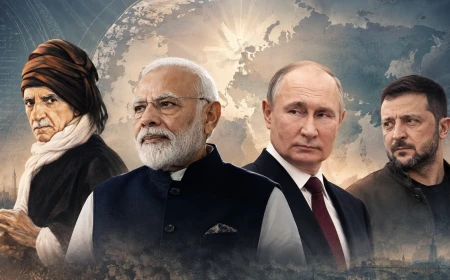
Some observers may also read these developments through a broader historical and civilizational lens. The influential Islamic scholar Bediuzzaman Said Nursi spoke in the early 20th century about the future importance of regions such as Turkistan, Egypt and India in world affairs. His reflections were not modern geopolitical forecasts in the technical sense, but they continue to be interpreted by some readers as pointing toward a future in which Asian and Muslim-majority societies gain greater global weight.
From this perspective, Armenia’s election can be seen not as the fulfillment of a single prophecy, but as one sign of a wider transformation: the weakening of old imperial centers and the emergence of new regional actors. Central Asia, India, Turkey, the South Caucasus and the broader Middle East are no longer passive spaces between great powers. They are increasingly becoming centers of decision, trade and diplomacy.
Russia’s invasion of Ukraine may have accelerated this transformation. Instead of restoring Moscow’s empire, the war may have encouraged former Soviet societies to ask whether their future should be tied to Russia’s military ambitions or to a more diversified world order.
This interpretation should be handled carefully. Elections are shaped by local realities, economic interests and domestic politics. But it is also true that geopolitical changes often become visible first through small political shifts. Armenia’s vote may be one of those shifts.
The limits of the Western victory narrative
It would be misleading to describe Pashinyan’s victory as a complete Western victory over Russia. Armenia is not yet an EU candidate country. Its EU membership remains a distant possibility. It still belongs to the Eurasian Economic Union and still relies on Russia in important economic sectors.
The Armenian public is also divided. Many voters remain angry over Karabakh. Pashinyan’s critics accuse him of making painful concessions to Azerbaijan and failing to defend former Karabakh leaders detained in Azerbaijan. Polling cited in the BBC report showed that 44% of Armenians supported the peace agreement with Azerbaijan, while 41% opposed it.
That division matters. Pashinyan’s new mandate is strong enough to govern, but not strong enough to ignore national trauma. His government must prove that peace with Azerbaijan, closer relations with the West and reduced dependence on Moscow can bring security and economic stability.
If that promise fails, pro-Russian or nationalist forces may return with greater strength.
Moscow’s empire is not gone, but its aura is fading
The deepest meaning of the Armenian election may be psychological. Russia still has economic power, military assets, intelligence networks, political allies and energy leverage. But the aura of inevitability around Russian dominance is fading.
For years, many regional leaders assumed that crossing Moscow’s red lines was too dangerous. Armenia’s election suggests that public opinion may now be willing to test those limits when Russian protection no longer appears reliable.
This is why the result matters for Ukraine, Central Asia, Belarus and the wider post-Soviet world. It shows that Russia’s war has not rebuilt a sphere of control. It may instead be helping to break the mental structure that kept many countries inside that sphere.
Pashinyan’s victory does not mean Russia has already lost the region. But it does mean the region is no longer waiting for Moscow’s permission to imagine another future.
Yusuf Inan
Yusuf Inan is a journalist and writer. He serves as Editor-in-Chief of UAPresa.com, WiseNewsPress.com, SehitlerOlmez.com and YerelGundem.com, and specializes in strategic and political analysis of Turkish and global affairs.
What's Your Reaction?
 Like
0
Like
0
 Dislike
0
Dislike
0
 Love
0
Love
0
 Funny
0
Funny
0
 Wow
0
Wow
0
 Sad
0
Sad
0
 Angry
0
Angry
0

Editor | Wise News Press — Delivering accurate, timely global news with integrity, insight, and editorial responsibility.
















Comments (0)