



Zelenskyy: Ukraine must neutralize Russian missiles with air defenses
Zelenskyy urged stronger air defenses after Russian drones and ballistic missiles hit infrastructure and homes across several Ukrainian regions.


By Ahmet Taş | Wise News Press
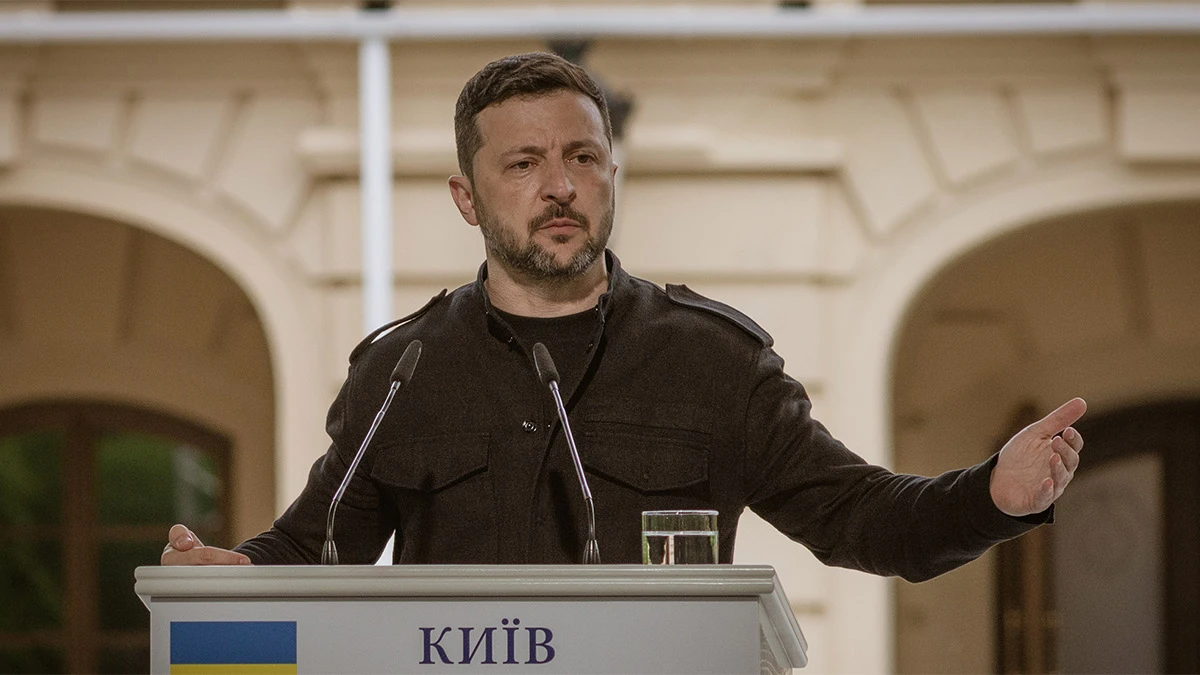
KYIV, UKRAINE — Ukrainian President Volodymyr Zelenskyy called for stronger air defenses after Russia launched an overnight combined attack with drones and ballistic missiles, damaging critical infrastructure and residential areas across several Ukrainian regions.
Zelenskyy said Moscow continues to invest in missile production and expand its war effort, arguing that Ukraine and its partners must strengthen the country’s ability to intercept ballistic missiles if they want to reduce Russia’s capacity to continue large-scale attacks. His appeal came as Ukrainian emergency services worked across several regions to deal with the consequences of the August 27 barrage.
Russian strikes hit infrastructure and residential areas
According to Zelenskyy, Russian forces struck critical infrastructure in the Poltava, Sumy and Kherson regions during the overnight assault.
Residential buildings were also hit in the Kharkiv region, while a guided aerial bomb struck a multi-storey apartment building in Kramatorsk.
The Ukrainian president said State Emergency Service teams rescued four people in Kramatorsk. Three people were reported injured in Zaporizhzhia and two in Kryvyi Rih. An apartment building in Odesa was also struck, while emergency crews were deployed to Chubynske in the Kyiv region to extinguish fires at enterprises following a drone attack.


The Ukrainian authorities’ initial statements did not suggest that a single region was the sole focus of the operation. Instead, the attack affected locations across the south, east, north and center of the country.
Reuters reported that Kyiv and several other regions came under attack and that industrial, energy, port and other infrastructure was damaged during the overnight barrage.
Ukraine says 258 drones were launched overnight
The Ukrainian Air Force later provided further details about the scale of the attack.


According to the Air Force, Russia launched 258 strike and decoy drones, including Shahed, Gerbera, S8000 Banderol and Parodiya-type aircraft. Russian forces also used two Onyx anti-ship missiles and Iskander-M/KN-23 ballistic missiles.
Ukrainian air defenses said they neutralized 233 aerial targets, including one Onyx missile, seven ballistic missiles, three S8000 Banderol weapons and 222 drones.
Officials nevertheless recorded direct strikes at 15 locations and debris from intercepted weapons at another 11 sites. The main directions of the attack included the Odesa, Kyiv, Dnipropetrovsk, Poltava and Zaporizhzhia regions.
Reuters also reported that at least one person was killed and several others were injured in the wider overnight attacks, citing Ukrainian officials.
Zelenskyy puts ballistic missile defense at center of appeal
Zelenskyy used the latest attack to renew his call for additional air-defense capabilities, particularly systems capable of intercepting ballistic missiles.
He said European allies had taken important decisions during the week to strengthen Ukraine’s air defenses but argued that further ballistic missile defense packages were needed.
The Ukrainian president specifically referred to support through the Prioritized Ukraine Requirements List, or PURL, as one of the mechanisms through which additional protection could be provided.
“Everything that strengthens the protection of our sky saves Ukrainian lives every day,” Zelenskyy said.
He argued that weakening Russia’s ability to conduct missile attacks was essential to changing Moscow’s calculations about continuing the war.
Zelenskyy’s statement reflects Kyiv’s continuing concern about ballistic missiles, which are more difficult to intercept than many slower aerial threats and require advanced air-defense systems.
Air defense shortages remain a major challenge
Ukraine has repeatedly asked its Western partners for additional high-end air-defense systems and interceptor missiles as Russia expands the scale and complexity of its aerial attacks.
Ballistic missile defense has become particularly important because only a limited number of systems available to Ukraine are capable of reliably engaging such targets.
Recent Russian attacks have combined several types of drones and missiles in an effort to place simultaneous pressure on Ukraine’s detection and interception capabilities.
The August 27 attack again included large numbers of drones alongside ballistic and other missile systems, forcing Ukrainian aviation, anti-aircraft missile units, electronic warfare teams, unmanned systems units and mobile fire groups to respond across several parts of the country.
The scale of the assault illustrates why Kyiv continues to seek both additional launch systems and a steady supply of interceptor missiles rather than relying only on existing air-defense batteries.
Moscow says its strikes target war-related facilities
Russia and Ukraine continue to give differing accounts of the purpose and effects of Russian strikes.
The Russian Defense Ministry described the August 27 operation as a large-scale attack against war-related targets in several Ukrainian cities, including industrial facilities, oil infrastructure, logistics centers and ports, according to reporting by The Associated Press and The Washington Post.
Ukrainian authorities, however, reported damage to residential buildings and other civilian sites in multiple regions.
The differing claims are part of a recurring pattern in the war: Moscow says its long-range attacks are directed at military or military-supporting infrastructure, while Ukrainian officials regularly report civilian casualties and damage to homes, businesses and public infrastructure.
The August 27 strikes occurred amid continuing Ukrainian attacks against targets inside Russia, including industrial and logistical facilities, as both sides increasingly use long-range drones and missiles against infrastructure away from the front line.
Kyiv wants European decisions followed by more interceptors
Zelenskyy’s immediate focus after the attack was not only on documenting the damage but also on converting recent political commitments from Ukraine’s allies into additional defensive capability.
He welcomed decisions taken by European partners during the week but said those measures needed to be supplemented by further packages capable of countering ballistic missiles.
For Kyiv, the challenge is increasingly one of sustainability: Ukraine must be able to defend multiple cities and infrastructure sites while Russia continues producing and launching missiles and drones over an extended period.
Zelenskyy argued that every improvement in air defense directly reduces the human cost of Russian attacks.
His broader message was that defensive support should also have a strategic effect. If Ukraine can increasingly neutralize the missile capability Moscow relies on, he said, Russia’s ability to sustain and expand the war could be weakened.
The appeal came as emergency crews continued clearing damaged sites and Ukrainian officials assessed the full consequences of one of the latest large-scale combined Russian air attacks.
WiseNewsPress.com
What's Your Reaction?
 Like
0
Like
0
 Dislike
0
Dislike
0
 Love
0
Love
0
 Funny
0
Funny
0
 Wow
0
Wow
0
 Sad
0
Sad
0
 Angry
0
Angry
0

Ahmet Taş is a journalist, editor and Turkey Office Manager of the Wise News Press Media Group. He works across news, digital media and international publishing, focusing on accurate, responsible and accessible journalism. He contributes to the development of media projects that bring important political, social and global developments to a wider international audience.

















Comments (0)