



Zero Waste, frugality and Islam: a global moral message to humanity
Emine Erdoğan’s Zero Waste initiative is examined alongside Islamic teachings on waste, Prophet Muhammad’s example and Said Nursi’s view of frugality.


By Yusuf İnan
Journalist | Political and Strategic Analyst
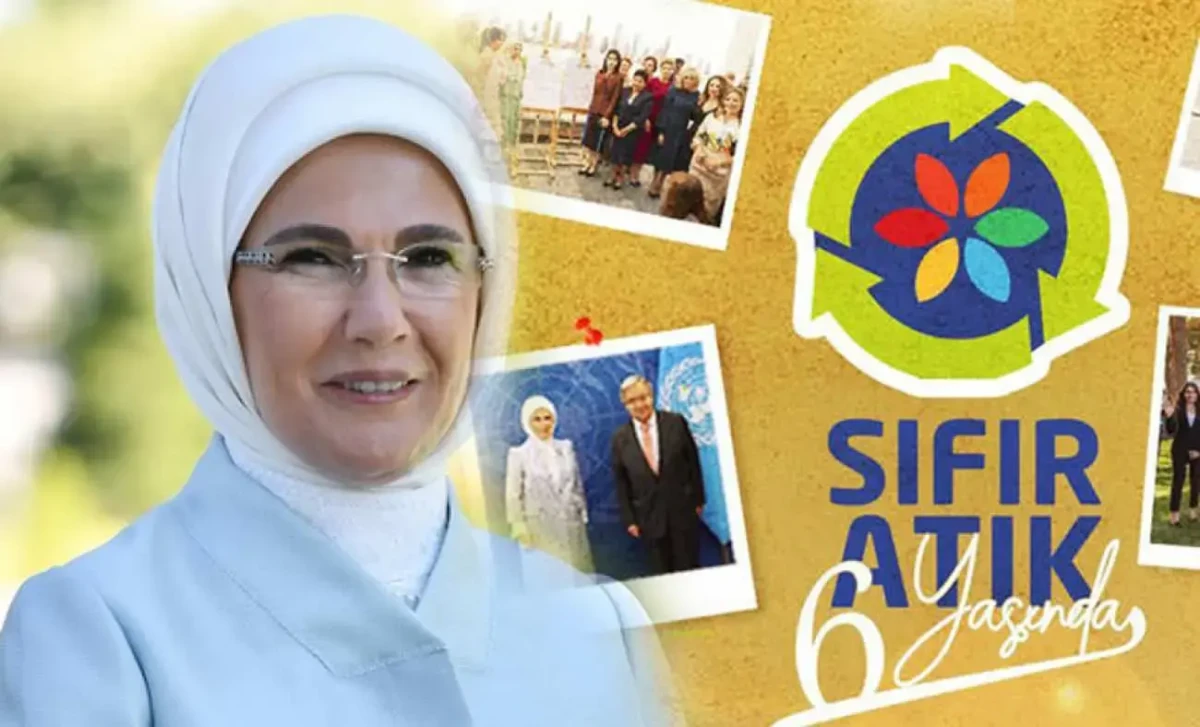
ANKARA, TURKIYE — Emine Erdoğan’s Zero Waste initiative can be read not only as an environmental project, but also as a moral reminder that echoes Islam’s long-standing warning against wastefulness.
The question is not whether the project is officially presented as a religious preaching campaign. It is not. Its formal language is environmental, institutional and diplomatic. Yet when the initiative is placed beside the Qur’anic command against waste, Prophet Muhammad’s measured use of water even during ablution, and Bediuzzaman Said Nursi’s principles in the Treatise on Frugality, a broader reading becomes possible.
In that reading, Zero Waste appears as a modern civic language through which an old Islamic moral principle is translated into global environmental practice.


A project beyond technical waste management
Türkiye’s Zero Waste initiative began in 2017 under the auspices of First Lady Emine Erdoğan and later gained international recognition. The United Nations’ designation of 30 March as International Day of Zero Waste gave the project a global diplomatic dimension and placed Türkiye’s experience inside a wider conversation about circular economy, resource protection and sustainable living.
At its official level, Zero Waste is about reducing waste, increasing recycling, improving resource management and changing consumption habits. It is a public policy and awareness project. But the subject it addresses is not purely technical. Waste is never only about bins, plastic, paper or recycling systems. It is also about how human beings see the world.
A society that wastes food, water, energy and goods also reveals something about its moral order. It shows whether blessing is treated as a trust or as disposable material. This is where Zero Waste becomes more than a municipal or environmental agenda. It becomes a language of responsibility.


The Qur’anic principle: eat, drink, but do not waste
Islam’s approach to consumption is built on balance. The Qur’anic instruction, “Eat and drink, but do not waste,” does not reject the use of blessings. It rejects excess, arrogance and heedlessness in the use of blessings.
This principle is deeply relevant to the modern age. Waste today is not limited to a plate of food left unfinished or water running from a tap. It includes energy waste, fast fashion, plastic pollution, unnecessary consumption, food thrown away by households and restaurants, and natural resources used without regard for the poor or for future generations.
In Islamic ethics, waste is not merely a financial mistake. It is a failure of gratitude. It means treating a blessing as if it has no giver, no purpose and no social responsibility attached to it.
This is why the Zero Waste message can be seen as compatible with Islamic moral teaching. Even when it is expressed in the language of climate, recycling and sustainability, the deeper idea is familiar: consume with measure, respect the blessing and do not destroy what has been entrusted to you.
Prophet Muhammad’s example: no waste even in worship
One of the most striking examples in Islamic tradition is the warning against wasting water during ablution. The reported teaching that water should not be wasted even beside a flowing river carries a powerful ecological meaning.
Ablution is an act of worship. It is pure, legitimate and spiritually meaningful. Yet even there, excess is discouraged. This shows that in Islamic ethics, the rightness of an action does not justify wastefulness in its method.
This point is especially important today. Modern societies often assume that abundance permits carelessness. If water is available, it is used excessively. If food is affordable, it is thrown away. If goods are cheap, they are replaced rather than repaired. The Prophetic example challenges this mentality.
It teaches that the abundance of a resource does not remove moral responsibility. A river flowing in front of a person does not make waste acceptable. By the same logic, a supermarket full of food, a city full of electricity or a home full of goods does not make extravagance morally neutral.
Zero Waste, when read through this Prophetic lens, becomes a contemporary form of disciplined stewardship.
Said Nursi’s Treatise on Frugality: economy as gratitude
Bediuzzaman Said Nursi’s Treatise on Frugality offers a spiritual framework that is highly relevant to today’s environmental debate. Nursi does not present frugality merely as a way to save money. He presents it as respect for bounty, a form of gratitude and a protection against moral and social decline.
In Nursi’s view, wastefulness is contrary to thankfulness. It belittles the blessing and causes loss. Frugality, by contrast, honors the blessing and opens the door to abundance, dignity and contentment.
This is a deeper language than modern sustainability discourse, but the practical outcome is similar. Sustainability says resources are limited and should be used responsibly. Nursi says blessings are entrusted to human beings and should be treated with gratitude. One speaks in ecological terms, the other in spiritual terms, but both oppose heedless consumption.
For this reason, the Treatise on Frugality can be read as an Islamic moral foundation for today’s Zero Waste consciousness. It gives the movement an inner meaning: recycling is not only a technical habit; it can also be a sign of respect for bounty.
Where Zero Waste and Islamic frugality meet
The meeting point between Emine Erdoğan’s Zero Waste initiative and Islamic frugality is the transformation of consumption habits. Zero Waste asks people to reduce, reuse, recycle and rethink. Islamic frugality asks people to avoid excess, respect blessings, live with contentment and remember accountability.
The two languages are not identical. One belongs to public policy and environmental diplomacy. The other belongs to faith, ethics and spiritual education. Yet they converge on a common human problem: waste.
A person who avoids throwing food away, uses water carefully, repairs usable items, separates recyclable waste and buys only what is needed is not merely making a lifestyle choice. That person is practicing a moral discipline.
In this sense, Zero Waste can be interpreted as a form of practical moral education. It does not need to use religious terminology to convey a value that Islam has long emphasized. The act itself can carry the message.
Is this a form of guidance and outreach?
The word “tabligh” usually means conveying the message of Islam, while “irshad” refers to guidance, moral direction and spiritual orientation. These are often associated with speech, sermons, books and direct religious teaching. But Islamic tradition also recognizes the power of example.
A community that reduces waste, protects water, prevents food loss and respects resources gives a message through action. This can be called a form of indirect or practical guidance. It does not force a religious identity onto an environmental project, but it shows how an Islamic value can be lived in a universal language.
Therefore, it would be too strong to say that the Zero Waste initiative is officially an Islamic preaching campaign. That is not its stated framework. But it is fair to say that the project can function as a values-based moral outreach that is deeply compatible with Islamic teachings on waste, gratitude and responsibility.
It speaks to Muslims through familiar moral principles and to the wider world through the shared language of sustainability.
Waste, hunger and the moral crisis of modern consumption
The global contrast between food waste and hunger makes the issue even more urgent. UN figures show that enormous amounts of food are wasted daily while hundreds of millions of people face hunger or food insecurity. This is not just an economic inefficiency. It is a moral contradiction.
Islam’s warning against waste becomes sharper in this context. Waste is not only what a person does with their own property. It also has a social meaning. When food is wasted while others go hungry, the act carries an ethical burden. When water is wasted while regions face drought, waste becomes a question of justice. When natural resources are consumed without regard for future generations, waste becomes a betrayal of trust.
Said Nursi’s idea of frugality as gratitude directly challenges this culture. A grateful person does not treat blessings as disposable. A frugal society does not measure progress only by how much it consumes. It also asks how much it preserves, shares and respects.
A global environmental language with moral roots
Emine Erdoğan’s Zero Waste initiative gained significance because it moved from a national awareness project to an international platform. By entering the UN agenda, it became part of global environmental diplomacy.
This matters because modern diplomacy is no longer limited to security, trade and borders. Climate change, food waste, water scarcity and pollution have become moral and political issues of the century. Countries now communicate values through environmental projects as much as through speeches.
In this context, Zero Waste gives Türkiye a value-based message to present internationally: resources are not unlimited, waste is not harmless and consumption must be disciplined.
For Muslim societies, this message can also be connected to religious memory. The Qur’an warns against waste. The Prophet teaches moderation even in worship. Said Nursi explains frugality as gratitude. Zero Waste translates these principles into modern institutional practice.
A modern reminder, not a formal religious campaign
The most balanced conclusion is this: Emine Erdoğan’s Zero Waste project should not be described narrowly as a formal Islamic tabligh campaign. Its official identity is environmental and global. Yet it can be interpreted as a modern moral reminder that carries strong harmony with Islamic teachings.
It reminds humanity that waste is not neutral. It harms the poor, burdens the planet, weakens gratitude and deepens injustice. It invites people to live with measure, responsibility and respect for blessings.
In a world where consumption has become almost a religion of its own, such a message has spiritual weight even when spoken in environmental language. Zero Waste may not preach in the conventional sense, but it can guide by example.
That is why the project can be read as a contemporary bridge between Islamic frugality and global sustainability: a practical call to reduce waste, protect blessings and remember that the earth is not a warehouse for human excess, but a trust placed in human hands.
Yusuf Inan
Yusuf Inan is a journalist and writer. He serves as Editor-in-Chief of UAPresa.com, WiseNewsPress.com, SehitlerOlmez.com and YerelGundem.com, and specializes in strategic and political analysis of Turkish and global affairs.
What's Your Reaction?
 Like
0
Like
0
 Dislike
0
Dislike
0
 Love
0
Love
0
 Funny
0
Funny
0
 Wow
0
Wow
0
 Sad
0
Sad
0
 Angry
0
Angry
0

Editor | Wise News Press — Delivering accurate, timely global news with integrity, insight, and editorial responsibility.



















Comments (0)