



From Yavuz to the Mecca Pact: Türkiye’s search for regional order
A comparison of Yavuz Sultan Selim’s era and the Mecca Pact suggests a shift from imperial expansion to shared regional security and strategic ownership.


By Yusuf İnan | Wise News Press
Journalist and Author | Political and Strategic Analyst
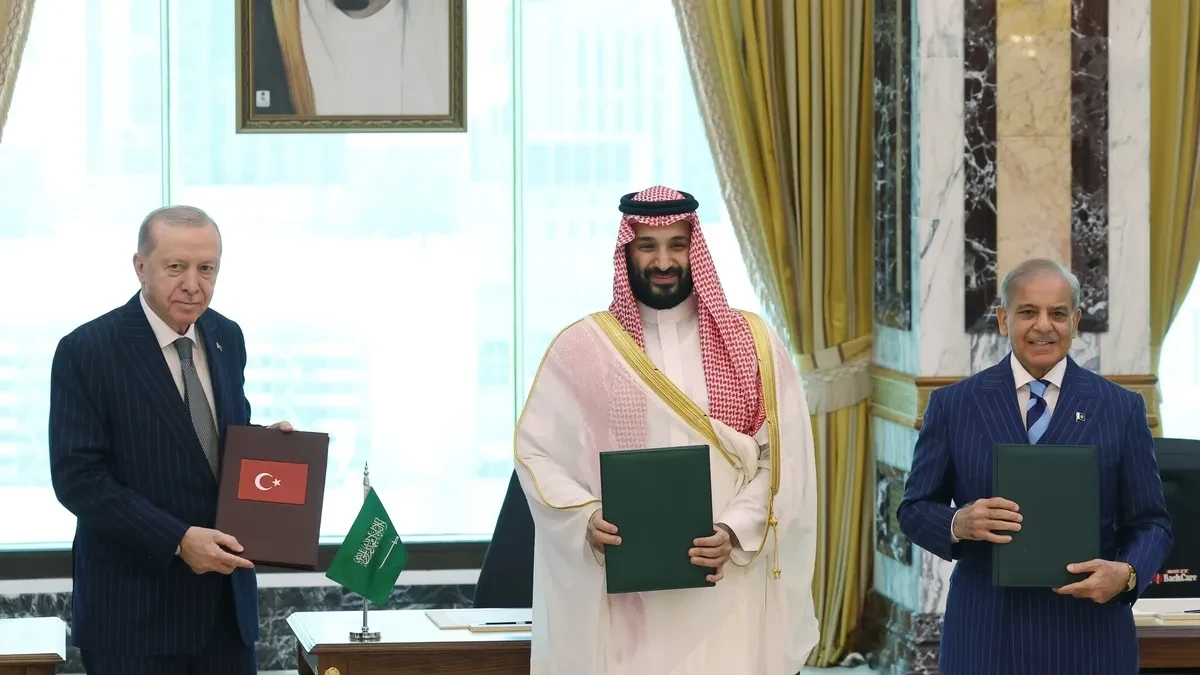
ANKARA, TURKEY — The Mecca Pact between Türkiye, Saudi Arabia and Pakistan can be read not simply as a defence agreement, but as part of a broader effort by regional powers to assume greater responsibility for their own security.
Viewed through a historical lens, certain structural parallels can be drawn with the transformation associated with Ottoman Sultan Yavuz Sultan Selim in the early 16th century. Yet the most useful comparison is not one of caliphate, empire or restored sovereignty. It lies instead in the conversion of military capacity into political influence, the search for regional ownership and the attempt to build a wider security order in response to a changing strategic environment.


That distinction matters. It allows the comparison to be understood in a way that is less ideological, more analytical and more compatible with the interests of Türkiye’s Western allies, Saudi Arabia, Egypt, Pakistan and the wider Muslim world.
The Yavuz era was also a response to a changing security environment
Yavuz Sultan Selim’s campaigns are often described primarily in terms of conquest. But the developments between 1514 and 1517 can also be understood as an Ottoman response to a rapidly changing regional balance.
To the east, the Safavid state under Shah Ismail was expanding its power. To the south, the Mamluks controlled Syria and Egypt. At the same time, Portuguese expansion in the Indian Ocean and around the Red Sea was beginning to affect traditional trade routes and the security environment surrounding the wider Islamic world.


The Ottoman victory at Chaldiran in 1514 altered the balance in eastern Anatolia. The Battle of Marj Dabiq in 1516 then brought Syria under Ottoman control, while the Battle of Ridaniya in 1517 opened the way to Cairo and ended Mamluk political rule.
The strategic result was larger than territorial expansion alone.
Anatolia, Syria, Egypt, the eastern Mediterranean, the Red Sea and the Hijaz became increasingly connected within one security and political framework. The Ottoman state emerged with far greater influence over the routes linking the Mediterranean, Egypt and the holy cities.
This is where the comparison with the Mecca Pact becomes useful.
The similarity is not in the method. Sixteenth-century states built security orders through war, conquest and direct sovereignty. Twenty-first-century states operate through treaties, alliances, institutional mechanisms, defence cooperation and mutual guarantees.
The parallel is therefore found in strategic logic rather than political form.
The core of the Mecca Pact is regional ownership, not hierarchy
The most significant idea behind the Mecca Pact is the concept that regional states should not rely exclusively on external powers to guarantee their security.
For Türkiye, this fits a broader foreign-policy trajectory that has been developing for years: preserving existing alliances while also building additional mechanisms with neighbouring and regional states.
In that sense, the pact does not necessarily need to be interpreted as an alternative to NATO or as an anti-Western structure.
A more realistic reading is that it could become a mechanism for regional burden-sharing and strategic self-reliance.
That distinction is especially important for Washington and European capitals.
Western governments have long encouraged regional partners to invest more in their own defence, develop local capabilities and assume a larger share of responsibility for regional stability.
If the Mecca Pact develops in a transparent and predictable way, it could be seen as compatible with that logic rather than inherently opposed to it.
Türkiye can remain a NATO member while simultaneously pursuing security cooperation with Saudi Arabia, Pakistan and other regional partners.
The critical question is not whether the pact is “for” or “against” the West, but whether it can operate in a way that contributes to stability without creating new rival blocs.
Saudi Arabia is a central partner, while Mecca is a shared symbol
The name and location of the pact naturally carry historical and religious symbolism.
But that symbolism should not be interpreted as a transfer of authority over the holy cities or as an attempt by Türkiye to assume a new religious-political status.
The present structure is fundamentally different.
Saudi Arabia is not a secondary participant. It is one of the core founding states of the arrangement. Mecca and Medina remain under Saudi sovereignty, and the Custodian of the Two Holy Mosques remains a central element of the Saudi state’s identity.
For that reason, the most constructive historical comparison is not:
“The Hijaz is again moving under Turkish leadership.”
It is instead:
“Mecca has become the symbolic birthplace of a wider regional security initiative involving several major Muslim states.”
That is a much more accurate reading of the contemporary reality.
Türkiye contributes military experience, defence technology and strategic depth. Saudi Arabia contributes financial power, energy influence and diplomatic weight. Pakistan brings a large military establishment and significant strategic capabilities.
These are complementary assets.
The emerging structure therefore looks less like a hierarchy and more like a multi-centred strategic partnership.
That distinction reduces unnecessary concern in Riyadh and also makes the pact more attractive to possible future members.
Egypt should be seen as a potential strategic partner, not a missing link
Egypt is perhaps the most sensitive part of any historical comparison with Yavuz Sultan Selim.
In Turkish historical memory, 1517 is associated with Ottoman expansion and the rise of imperial power. In Egyptian historical memory, the same period marks the end of Mamluk rule and the beginning of Ottoman domination.
For that reason, describing Egypt today as the “next link” in a historical chain would be strategically unhelpful.
Egypt’s importance in the Mecca Pact context has an entirely different basis.
It controls the Suez Canal, has major influence in the Red Sea and eastern Mediterranean, possesses one of the largest Arab military establishments and remains one of the most important political centres of the Arab world.
If Cairo were eventually to join such a framework, that should not be interpreted as Egypt accepting Turkish leadership.
It would instead mean that Egypt had chosen, on the basis of its own sovereignty and strategic interests, to become another major pillar of a broader regional system.
A widened framework could then combine:
Türkiye’s defence industry and NATO experience,
Saudi Arabia’s financial and energy resources,
Pakistan’s military capacity,
and Egypt’s strategic position in the Arab world, the Suez Canal and the Red Sea.
Such an arrangement could become far more significant than a simple trilateral pact.
But its success would depend on one principle: no member should be treated as another state’s sphere of influence.
The pact should not become a sectarian or anti-state bloc
One of the greatest risks in historical analogy is the temptation to map the Ottoman-Safavid rivalry directly onto today’s Middle East.
That would be misleading.
The rivalry between Yavuz Sultan Selim and the Safavids had both geopolitical and sectarian dimensions. Reproducing that framework today as a Türkiye-Saudi Arabia-Pakistan versus Iran confrontation would risk creating precisely the kind of sectarian bloc politics that the region has struggled with for decades.
The strategic value of the Mecca Pact will not come from turning Iran into a permanent enemy.
Iran is a major and enduring regional power. The security of Türkiye, the Gulf, Iraq, Pakistan and Iran cannot be completely separated from one another.
A sustainable regional order therefore requires deterrence on one side and diplomatic channels on the other.
The same principle applies to Israel.
If the pact is framed as an alliance against a specific country, its ability to expand and gain international legitimacy will be limited.
If, however, it presents itself as a defensive framework designed to reduce vulnerability, increase coordination and prevent unilateral destabilisation, it will be more credible.
Regional order-building should mean managing rivalries, not institutionalising new ones.
Türkiye’s most valuable role may be that of a founding power, not a supreme leader
This is where the Erdoğan-Yavuz comparison requires the greatest care.
The Ottoman system of the 16th century was a centralised imperial hierarchy. The modern Middle East is composed of sovereign nation-states with their own political identities, strategic interests and historical sensitivities.
Türkiye’s realistic role today is therefore not to become the sole political leader of the Muslim world.
A more sustainable role would be to become one of the principal states capable of creating institutions, producing security and connecting different geopolitical spaces.
That could actually give Ankara more influence than a symbolic claim to leadership.
Türkiye can simultaneously remain part of NATO, deepen cooperation with Saudi Arabia and Pakistan, develop relations with Egypt, maintain dialogue with Iran and strengthen links with Central Asia, the Caucasus and the Gulf.
That is less a model of bloc leadership and more a model of a connector state.
In modern geopolitics, states often gain influence not because they dominate every partner, but because they can connect otherwise separate political, military and economic systems.
Seen from this perspective, the relevant lesson from Yavuz’s era is not empire. It is the ability to understand changing balances of power and reposition the state accordingly.
Military capacity matters most when it produces stability
Türkiye’s growing defence industry gives the Mecca Pact an important practical foundation.
But its strategic value is not simply the ability to sell weapons.
If cooperation develops in areas such as joint production, military training, logistics, intelligence coordination, air and missile defence, interoperability and joint exercises, the participating states could gradually create deeper institutional ties.
The more important equation is therefore:
Defence capacity → deterrence → security → economic stability → political cooperation.
In the 16th century, Ottoman military superiority translated into political expansion.
In the 21st century, military capability is more useful when it reduces the likelihood of war rather than facilitating conquest.
That should ultimately be the standard by which the Mecca Pact is judged.
Its historical significance would not come from the number of conflicts it enters, but from the number of conflicts it helps prevent.
The real comparison is not ‘new Ottomanism’ but a new regional balance
A comparison between Yavuz Sultan Selim’s era and the Mecca Pact is therefore possible, but only if it is made carefully.
The strongest common theme is not caliphate, religious authority or imperial restoration.
It is state capacity, strategic adaptation and regional order-building.
Between 1516 and 1517, the Ottoman state reshaped the political geography of Syria, Egypt and the Hijaz through the methods available in that period.
In 2026, Türkiye, Saudi Arabia and Pakistan are attempting something fundamentally different: building a collective security mechanism while preserving their sovereignty.
That difference is decisive.
For Erdoğan, the most meaningful historical parallel with Yavuz is therefore not the pursuit of a religious title, but the attempt to use national capacity to shape a broader regional environment during a period of international uncertainty.
The future importance of the Mecca Pact will depend not on whether Türkiye becomes the dominant state within it, but on whether Türkiye, Saudi Arabia, Pakistan and potentially Egypt and other states can create a functioning security architecture based on sovereign equality.
If such a structure remains compatible with Western partnerships, avoids sectarian exclusion of Iran, respects Egypt’s independent strategic weight, recognises Saudi Arabia’s central role in the Hijaz and preserves Pakistan’s status as a founding partner, it could gain far greater international legitimacy.
From that perspective, the opportunity before the Mecca Pact is not to recreate a past empire.
It is to build something that did not exist in Yavuz Sultan Selim’s world: a multi-centred regional security system based on partnership, sovereignty, mutual deterrence and institutional cooperation.
The historical resonance remains important, but the modern lesson is different.
The question is no longer who rules the region.
The real strategic question is whether the region’s major powers can build enough trust and capacity to secure it together.
Yusuf İnan
WiseNewsPress.com
Yusuf İnan is a journalist, author, and political and strategic analyst. He serves as editor-in-chief of UAPresa.com, WiseNewsPress.com, SehitlerOlmez.com, SiyasetinSesi.com and YerelGundem.com. His work focuses on strategic and political analysis concerning developments in Türkiye and around the world.
What's Your Reaction?
 Like
0
Like
0
 Dislike
0
Dislike
0
 Love
0
Love
0
 Funny
0
Funny
0
 Wow
0
Wow
0
 Sad
0
Sad
0
 Angry
0
Angry
0

Yusuf İnan is a journalist, columnist, strategic analyst and head of the Wise News Press Media Group. His work focuses on international affairs, geopolitics, security and major social issues. Through his journalism, he promotes peace, dialogue, mutual understanding and responsible reporting while contributing to the development of international media projects.














Comments (0)