



Modi’s peace call to Putin tests Russia’s ties with the Global South
Modi’s call to end the Ukraine war, following Tokayev’s appeal, raises a larger question: are Russia’s strategic partners starting to demand an exit?


By Yusuf İnan | Wise News Press
Journalist and Author | Political and Strategic Analyst
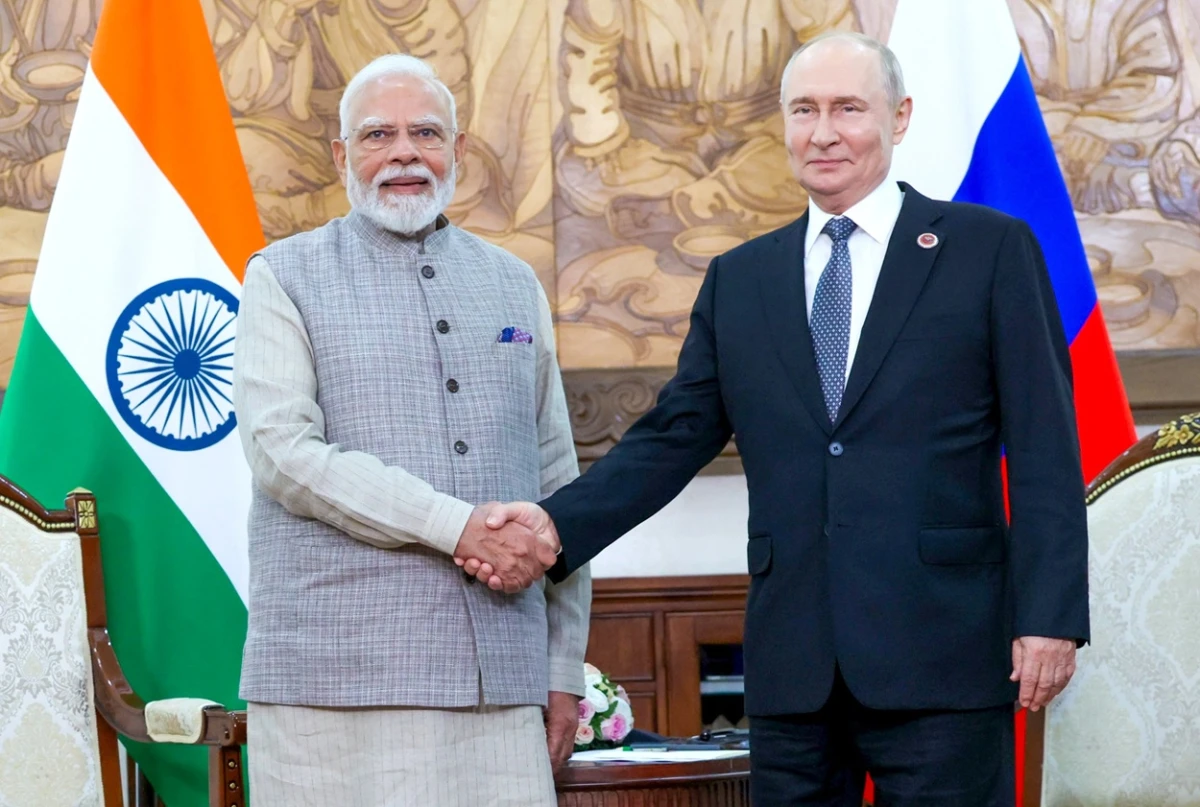
BISHKEK, Kyrgyzstan — Indian Prime Minister Narendra Modi’s public appeal to Vladimir Putin to move from an “endless war” toward ending the conflict in Ukraine carries greater strategic weight than an ordinary diplomatic call for peace.
Its significance lies not only in what Modi said, but in who said it.
The message did not come from NATO, the European Union or a government enforcing sanctions against Moscow. It came from one of Russia’s most important non-Western partners — a nuclear-armed power, a major buyer of Russian energy and a country Moscow frequently presents as a pillar of the emerging multipolar order.


And Modi’s intervention did not occur in isolation.
Just weeks earlier, Kazakhstan’s President Kassym-Jomart Tokayev publicly urged Putin to freeze the fighting and return to negotiations. Taken together, the two interventions raise a more consequential question than whether individual leaders support peace:
Is pressure to end the war beginning to move from Russia’s Western adversaries into Russia’s own strategic circle?


Why Modi’s words carry exceptional weight
His full name is Narendra Damodardas Modi, and he is the Prime Minister of India, serving his third consecutive term.
India’s geopolitical scale makes his intervention difficult to dismiss. The IMF’s 2026 profile puts India’s population at roughly 1.48 billion people, while the Indian government says the country became the world’s fourth-largest economy in 2025. SIPRI estimates that India possesses approximately 190 nuclear warheads, placing it among the nine nuclear-armed states.
India is simultaneously a member of the G20, BRICS and the Shanghai Cooperation Organisation, while also participating in the Quad with the United States, Japan and Australia.
That unusual positioning gives New Delhi access to political camps that increasingly struggle to communicate with one another.
When a German, British or Polish leader tells Putin to stop the war, Moscow can frame the demand as hostile Western pressure.
When Modi says it while India continues to describe Russia as a “Special and Privileged Strategic Partner,” that argument becomes much harder to make.
India’s own account of the Bishkek meeting underscores the paradox. Modi reiterated that dialogue and diplomacy were the way forward, while the two governments simultaneously agreed to deepen cooperation in energy, defence, space, trade and other fields. Modi also said he expected to welcome Putin to India for the BRICS summit on September 12–13.
This was not India breaking with Russia.
It was India telling Russia something potentially more uncomfortable:
We intend to remain your partner, but an indefinite war is increasingly incompatible with the international environment we want to build with you.
Tokayev and Modi point to a pattern Moscow cannot easily ignore
The context became more significant because of Kazakhstan.
On July 25, President Kassym-Jomart Tokayev stood alongside Putin in Omsk and called for the Russia-Ukraine conflict to be frozen and negotiations resumed, referring to a possible “Istanbul formula 2.0.”
Tokayev also argued that young Russians and Ukrainians should stop dying and suggested that security guarantees by major powers could help create conditions for an agreement. The Kremlin promptly pushed back, saying a freeze was impossible under existing circumstances.
Tokayev’s remarks mattered because Kazakhstan shares one of the world’s longest borders with Russia and remains deeply economically connected to Moscow.
Modi’s intervention carries a different kind of weight.
India is geographically distant, strategically autonomous and economically powerful enough to make independent choices. It therefore cannot easily be portrayed as speaking under Western pressure.
One appeal might be diplomatic noise.
Two prominent partners publicly questioning the continuation of the war begin to resemble a trend.
That does not mean Russia’s partners are turning against Moscow. It suggests something subtler: countries that want relations with Russia to continue may increasingly conclude that the war itself is becoming an obstacle to those relations.
This is strategic autonomy — not India joining the Western camp
Interpreting Modi’s comments as evidence of India moving into an anti-Russian coalition would be a serious analytical mistake.
New Delhi’s foreign policy remains centered on strategic autonomy.
India seeks strong relations with Washington because the United States is important for advanced technology, investment and Indo-Pacific security. At the same time, it deliberately maintains partnerships with Russia and other powers to avoid excessive dependence on any single bloc.
Recent Carnegie analysis argues that diversification remains fundamental to India’s strategy, with Russia retaining importance in defence, energy and New Delhi’s broader effort to preserve room for manoeuvre in an increasingly polarized system.
The same logic applies to China.
India has reopened dialogue with Beijing following years of severe border tensions, but deep strategic distrust remains. Carnegie’s 2026 assessment notes that New Delhi continues to balance border security, economic dependence on Chinese supply chains and geopolitical uncertainty while seeking a workable relationship with Beijing.
Modi therefore does not need to “choose” Washington over Moscow.
His message may instead reflect a calculation that a prolonged Russian war narrows India’s strategic options.
That is precisely why his words matter.
India may possess something rare: credibility with both Moscow and Kyiv
The second strategic dimension is mediation.
India is one of very few major powers that can maintain meaningful channels with Moscow, Kyiv and Washington simultaneously.
Modi demonstrated that capacity in August 2024, when he became the first Indian prime minister in modern history to visit Ukraine. During talks in Kyiv with President Volodymyr Zelenskiy, Modi urged dialogue with Russia and explicitly offered India’s assistance in efforts toward a peaceful settlement.
India’s position is therefore distinct from most potential mediators.
Western governments openly support Ukraine and are regarded by Moscow as parties to the wider confrontation.
China maintains considerably deeper strategic relations with Russia, including extensive military cooperation, which generates skepticism about Beijing’s neutrality.
Turkey retains exceptional access to both sides and has already demonstrated mediation capacity, but it remains a NATO member.
India occupies another space altogether.
It is not neutral in the sense of being detached — it has substantial interests with Russia — but that relationship may actually give it greater access to Putin than countries seen in Moscow as adversaries.
India could therefore become valuable not as an arbiter imposing a settlement, but as a facilitator capable of carrying messages, testing compromises and providing political cover for negotiations.
That possibility should not be overstated. Yet Modi’s increasingly direct rhetoric suggests New Delhi may be preparing to play a larger diplomatic role.
India’s strongest leverage is not diplomatic — it is oil
The greatest limitation of Modi’s peace message is also the source of India’s greatest potential influence.
Russian oil.
In July, Russian crude reached a record 50.83% of India’s total crude imports, equivalent to about 2.47 million barrels per day, according to Reuters. Russia averaged more than 43% of Indian crude imports between April and July.
India has strong reasons for buying it.
The country imports approximately 89% of its crude requirements, and the 2026 Middle East energy shock has made Russian supplies even more valuable to Indian refiners.
This means New Delhi cannot simply abandon Russian crude without economic consequences.
But it also means India possesses something that many advocates of peace lack:
leverage Moscow actually values.
If Modi continues calling for peace while energy flows remain completely disconnected from diplomacy, his intervention may remain largely symbolic.
If India gradually signals that future energy cooperation, investment or diplomatic support depends on greater Russian flexibility, the meaning of Bishkek changes substantially.
Economic pressure from India would not look like Western sanctions.
For Moscow, it would be pressure from a partner it needs.
Washington has its own reasons to watch Modi closely
The United States also has a significant stake in this equation.
Washington wants India strong enough to help balance China in the Indo-Pacific, but Russian energy ties remain a recurring source of friction.
The pressure is becoming more concrete. A U.S. sanctions bill that has passed the Senate would authorize tariffs of up to 100% against major buyers of Russian energy, potentially affecting India and China if it becomes law.
At the same time, Washington itself continues direct communication with Moscow. On August 31, U.S. Treasury Secretary Scott Bessent met Russian Finance Minister Anton Siluanov and reportedly told him that economic relief would not be available while the war continued.
That creates an opening for India.
Washington does not necessarily need New Delhi to become anti-Russian. A more strategically useful outcome could be India using its privileged relationship with Moscow to transmit pressure that Western governments cannot.
For the United States, Modi may therefore be most valuable precisely because Putin does not perceive him as an American proxy.
China adds another layer to India’s diplomatic opportunity
The China dimension is less visible but equally important.
Beijing remains Moscow’s most consequential Asian strategic partner, with deep military, political and economic ties. India is not in a position to replace China in that relationship.
But successful Indian peace diplomacy could create something Beijing does not automatically control: an alternative Asian channel to Moscow with credibility in Washington and Kyiv.
That would strengthen India’s claim to be an independent pole in a multipolar order rather than a secondary player choosing between U.S.- and China-led systems.
The Bishkek SCO summit itself illustrated the contradiction. China, Russia and India appeared together in an institution frequently presented as a counterweight to Western influence, yet the grouping contains significant internal differences, including enduring India-China tensions.
If Modi can simultaneously preserve Russian ties, deepen Western partnerships and acquire a meaningful diplomatic role in Ukraine, India’s global status would rise.
That may be one reason New Delhi has little incentive to remain permanently silent about the war.
Three paths now lead from Bishkek
There are three plausible ways to interpret what happens next.
The first is symbolism without leverage. Modi continues to call for peace, India keeps expanding economic ties with Moscow and Russia continues fighting without meaningful diplomatic concessions. In that case, Bishkek becomes another carefully worded Indian peace appeal.
The second is active mediation. India intensifies shuttle diplomacy between Kyiv and Moscow, perhaps alongside Turkey or other states, using its unusual access to both sides to explore ceasefire terms, security guarantees or phased negotiations.
The third — and strategically most consequential — is diplomacy backed by economic leverage.
If New Delhi begins quietly telling Moscow that the sustainability of Russian energy ties, investment or broader diplomatic cooperation depends on genuine movement toward negotiations, Russia would face a type of pressure fundamentally different from Western sanctions.
There is no evidence yet that India has taken that third step.
Indeed, the immediate military picture argues for caution. Russia continued major attacks on Ukraine after Modi’s remarks, with Reuters reporting 12 deaths in the Kyiv region on September 1 during a sixth consecutive day of Russian strikes.
The Kremlin has also shown no public sign of abandoning its core territorial and security demands.
For now, therefore, Modi’s statement should be treated as a signal, not a turning point.
But strategically important changes often begin as signals.
Russia has spent years arguing that Western isolation has failed because China, India, Central Asian states and much of the Global South continue engaging Moscow.
That argument remains partly true.
Yet it contains a vulnerability.
Countries do not need to join Western sanctions to conclude that Russia’s war has gone on too long. They do not need to become allies of Kyiv to see the conflict as economically disruptive. And they do not need to abandon Putin to tell him that the costs of continuing are becoming harder to justify.
The West has demanded an end to Russia’s war for years.
The more consequential development may be that Russia’s partners are increasingly beginning to say the same thing.
If India eventually turns those words into diplomatic or economic leverage, the Bishkek meeting may be remembered not simply as another appeal for peace, but as the moment when pressure on Moscow began moving from the Western perimeter into Russia’s own strategic circle.
Yusuf İnan
WiseNewsPress.com
Yusuf İnan is a journalist, author, and political and strategic analyst. He serves as editor-in-chief of UAPresa.com, WiseNewsPress.com, SehitlerOlmez.com, SiyasetinSesi.com and YerelGundem.com. His work focuses on strategic and political analysis concerning developments in Türkiye and around the world.
What's Your Reaction?
 Like
0
Like
0
 Dislike
0
Dislike
0
 Love
0
Love
0
 Funny
0
Funny
0
 Wow
0
Wow
0
 Sad
0
Sad
0
 Angry
0
Angry
0
Yusuf İnan is a journalist, columnist, strategic analyst and head of the Wise News Press Media Group. His work focuses on international affairs, geopolitics, security and major social issues. Through his journalism, he promotes peace, dialogue, mutual understanding and responsible reporting while contributing to the development of international media projects.









Comments (0)