



Modi’s peace call and Said Nursi’s vision of India, Turkestan and Egypt
Modi’s peace appeal to Putin highlights India’s rise while reviving Said Nursi’s 1910 reflections on India, Turkestan and Egypt in a changing world order.


By Yusuf İnan | Wise News Press
Journalist and Author | Political and Strategic Analyst
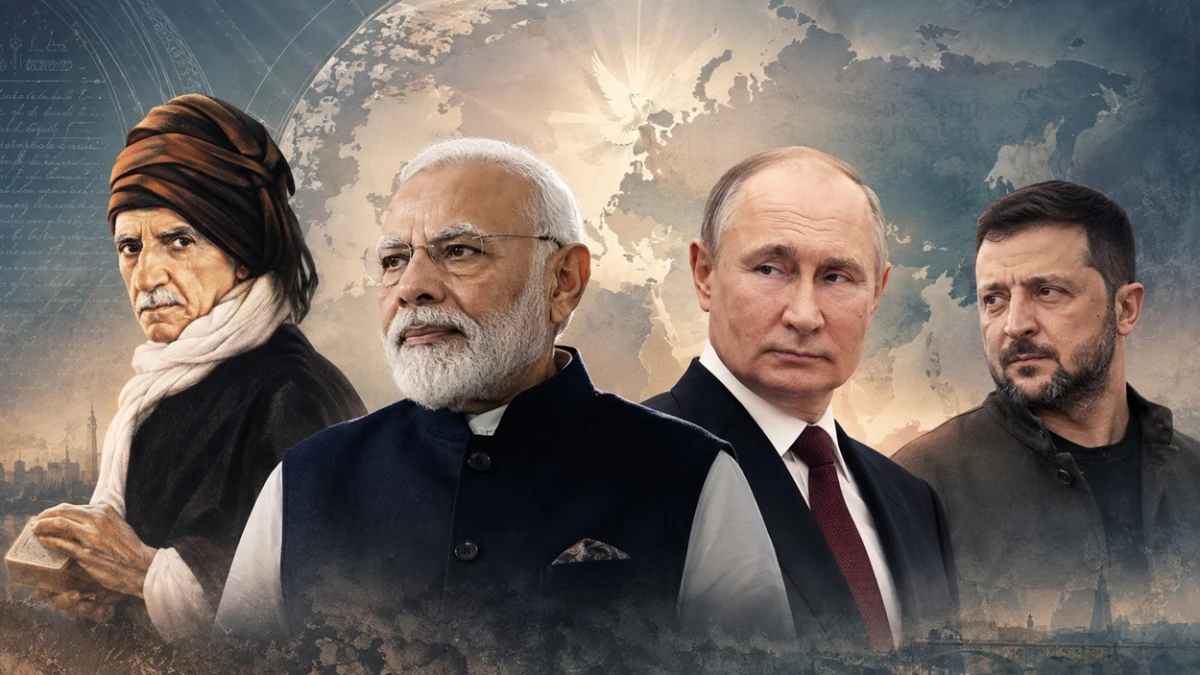
ANKARA, Türkiye — Indian Prime Minister Narendra Damodardas Modi’s message to Vladimir Putin that the world must move “from endless war toward an end to war” should be read not only through the lens of the Ukraine conflict, but also as part of a much larger transformation in which centers of global power are increasingly moving beyond the traditional Western axis toward Asia and the Global South.
The weight of Modi’s message does not come from India being an anti-Russian state. On the contrary, it derives precisely from New Delhi’s ability to maintain strong political, military and economic relations with Moscow while simultaneously building strategic partnerships with the United States, competing and negotiating with China, cooperating with Russia in BRICS and the Shanghai Cooperation Organisation, and maintaining direct diplomatic relations with Kyiv.
At this point, a striking historical parallel emerges from a conversation attributed to Bediuzzaman Said Nursi with a Russian policeman in Tbilisi in 1910, in which Nursi spoke metaphorically about the future of India, Egypt, the Caucasus and Turkestan.


Why Modi’s message matters: India’s growing weight
India is no longer simply a “large developing country.”
Its economy expanded by 7.8% year on year in the April-June quarter of 2026, underscoring the scale and momentum of a country that has become one of the world’s largest economic powers.
With a population approaching 1.5 billion, a vast domestic market, a major technology sector, a sophisticated space program, a growing defence industry and nuclear capabilities, India has become one of the central states in contemporary international politics.


According to SIPRI’s 2026 estimates, India possesses approximately 190 nuclear warheads.
Yet India’s real geopolitical value lies not only in material power.
New Delhi can simultaneously cooperate with the United States through the Quad, maintain what it describes as a special strategic relationship with Russia, sit at the same table with China in the Shanghai Cooperation Organisation, speak to the Global South through BRICS and maintain direct diplomatic engagement with Ukraine.
That is why Modi’s appeal to Putin is not simply another Western demand directed at Moscow.
It is a warning from a partner Russia needs.
The message to Putin: We are partners, but we do not want endless war
At the Bishkek meeting, Modi maintained cordial relations with Putin and welcomed the development of India-Russia economic ties.
At the same time, he told the Russian president that every additional day of war pushes humanity backward and that the conflict should move toward an end. India’s position continues to emphasize dialogue and diplomacy as the preferred route to resolving the war.
These two messages are not necessarily contradictory.
India’s position can be understood as follows:
“We do not want to lose Russia. But we also do not want our partnership with Russia to become hostage to an endless war.”
For Moscow, this represents a very different form of pressure from Western sanctions.
The Kremlin can dismiss criticism from Washington, Brussels or London as hostility from an adversarial bloc.
It is far more difficult to use the same argument against India.
Tbilisi, 1910: Said Nursi, India and a striking historical metaphor
Around 116 years ago, according to Tarihçe-i Hayat, Said Nursi left Istanbul for Van and travelled through Batumi and Tbilisi. While looking over the city from Sheikh San’an Hill, he entered into a conversation with a Russian policeman.
When the policeman argued that the Islamic world had become fragmented, Nursi replied in essence that these societies had “gone to study.”
He described India metaphorically as a capable child of the Islamic world studying in a British school, Egypt as an intelligent son learning under British administration, and the Caucasus and Turkestan as two courageous sons training in the Russian military school.
In versions of the passage preserved in the Risale-i Nur tradition, Nursi then envisages these societies completing their education and eventually taking positions of leadership across wider regions.
It would be methodologically unsound to present these words as a supernatural prediction of specific 21st-century geopolitical events.
But they can reasonably be read as an unusually optimistic early-20th-century political perspective: societies living under imperial or colonial domination could absorb institutional experience, emerge from subordination and eventually become independent centers of power.
Modern India makes that historical metaphor especially thought-provoking.
At the time of the Tbilisi conversation, India was under British rule.
Today it is powerful enough to tell the Russian president that a major war must end, to cooperate with Washington on defence and technology, to shape BRICS politics and to influence international energy markets.
India is not merely speaking diplomatically.
It has material influence over Moscow.
That is what gives Modi’s peace appeal its deeper significance.
‘Turkestan’ and the strategic autonomy of modern Central Asia
Nursi’s use of the term Turkestan should not be equated with a single contemporary country.
Historically, Turkestan referred to a broader Central Asian cultural and geographic space encompassing areas that today include Kazakhstan, Kyrgyzstan, Uzbekistan, Turkmenistan and other territories.
What is striking, however, is the transformation of the region that was once under Russian imperial and later Soviet control.
Central Asian states are increasingly pursuing multi-vector foreign policies, balancing Moscow, Beijing, Ankara, Brussels, Washington, the Gulf states and other actors rather than remaining dependent on a single power.
A 2026 study by the Swedish Defence Research Agency, FOI, concludes that Kazakhstan and Uzbekistan are using the emerging multipolar environment to strengthen sovereignty, diversify partnerships and help build a more autonomous regional order.
In other words, a region once perceived largely as an object of Russian or Soviet power is increasingly becoming an actor capable of articulating its own interests to Moscow.
Seen from the present, that creates an intriguing historical parallel with Nursi’s metaphor of Turkestan receiving training in the “Russian military school.”
Egypt represents another dimension of the same multipolar shift
The third important geography in Nursi’s account is Egypt.
Egypt does not possess India’s economic scale, but its geopolitical position remains exceptionally important.
It controls the Suez Canal, sits at the intersection of Africa and the Middle East, has one of the Arab world’s largest populations and is now part of BRICS.
More importantly, Cairo is also moving toward a model of strategic autonomy.
Egypt continues to maintain a significant security relationship with the United States while simultaneously expanding ties with China, Russia and Europe. Reuters reported during Xi Jinping’s September 2026 visit that Egypt has been diversifying its international partnerships as regional states reassess the reliability of established security arrangements.
The common line connecting India, Central Asia and Egypt is therefore becoming increasingly visible:
Rather than positioning themselves permanently around a single great power, these countries seek to expand their freedom of action by maintaining relations with several centers of power at once.
The deeper change: The world no longer operates only on a Washington-Moscow axis
This is where the 1910 conversation becomes especially interesting when viewed from the 21st century.
For much of the 20th century, the international system was dominated first by empires and later by the U.S.-Soviet bipolar structure.
By the second quarter of the 21st century, the global order is becoming more fragmented.
The United States remains one of the dominant powers.
China is increasingly powerful.
Russia retains considerable military and nuclear capacity.
Europe remains a major economic bloc.
But India, Türkiye, Saudi Arabia, Brazil, Indonesia, Egypt, Kazakhstan and other middle and major powers increasingly seek to formulate policy on their own terms.
The central question is therefore gradually shifting away from:
“Whose side are you on?”
toward:
“How many centers of power can you maintain meaningful relations with at the same time?”
And India is currently one of the countries playing that game most effectively.
This changes the strategic meaning of Modi’s message to Putin.
For years, Moscow has argued that Western efforts to isolate Russia have failed.
It points to China, India, BRICS, Africa and Central Asia as evidence that the West does not represent the entire international community.
But what happens if those same states continue trading and cooperating with Russia while also beginning to tell Moscow:
“This war needs to end”?
That is the deeper significance of messages coming from partners rather than adversaries.
How should Bediuzzaman Said Nursi’s words be read today?
The responsible way to bring the 1910 Tbilisi conversation into a modern geopolitical analysis is not to claim that Said Nursi literally predicted individual events of the 21st century.
A more meaningful reading is this:
Nursi did not regard societies under colonial or imperial domination merely as permanently defeated communities.
He interpreted their experience under British and Russian power as a kind of historical learning process, and imagined that these societies might eventually acquire independent political weight.
More than a century later:
India has become a global power.
Central Asia has emerged as a strategic region of independent states pursuing increasingly diversified foreign policies.
Egypt is repositioning itself at the intersection of Africa, the Middle East and the Global South.
These regions are no longer simply territories affected by the decisions of great powers.
They are increasingly actors seeking to influence the decisions of great powers themselves.
Modi’s message to Putin is one of the clearest contemporary examples of that transformation.
The emerging world order may not be shaped solely in Washington, Moscow and Beijing.
Its real character may increasingly depend on what countries from India to Central Asia, from Türkiye to Egypt, do with their expanding strategic autonomy.
Translated into the language of the 21st century, the metaphor Said Nursi used more than a century ago can be read this way:
The societies that once lived in someone else’s “school” are increasingly beginning to write their own foreign policy.
And that is precisely what makes India’s message to Putin more consequential than an ordinary appeal for peace.
Yusuf İnan
WiseNewsPress.com
Yusuf İnan is a journalist, author, and political and strategic analyst. He serves as editor-in-chief of UAPresa.com, WiseNewsPress.com, SehitlerOlmez.com, SiyasetinSesi.com and YerelGundem.com. His work focuses on strategic and political analysis concerning developments in Türkiye and around the world.
What's Your Reaction?
 Like
0
Like
0
 Dislike
0
Dislike
0
 Love
0
Love
0
 Funny
0
Funny
0
 Wow
0
Wow
0
 Sad
0
Sad
0
 Angry
0
Angry
0
Yusuf İnan is a journalist, columnist, strategic analyst and head of the Wise News Press Media Group. His work focuses on international affairs, geopolitics, security and major social issues. Through his journalism, he promotes peace, dialogue, mutual understanding and responsible reporting while contributing to the development of international media projects.










Comments (0)