



Pezeshkian tells Trump Iran will respond if US returns to Islamabad deal
Iranian President Masoud Pezeshkian said Tehran would respond immediately if Donald Trump recommits to the Islamabad memorandum, DW Türkçe reported.


By Ahmet Taş | Wise News Press
BISHKEK, KYRGYZSTAN — Iranian President Masoud Pezeshkian said Tehran would respond immediately and positively if U.S. President Donald Trump recommits to the obligations contained in the Islamabad Memorandum.
Speaking during the Shanghai Cooperation Organisation leaders’ summit in Bishkek, Pezeshkian accused Washington of abandoning commitments contained in the document signed by Trump and said Iran had so far responded proportionately to what it considered U.S. violations. His remarks, reported by DW Türkçe, signaled that Tehran still sees a possible diplomatic route despite renewed military exchanges.
Pezeshkian urges Trump to return to the memorandum
Pezeshkian used his appearance in the Kyrgyz capital to appeal directly to the U.S. administration over the Islamabad Memorandum.
According to DW Türkçe, the Iranian president said U.S. adherence to the document signed by Trump lasted less than two weeks because of what he described as Washington’s “excessive demands” and withdrawal from its commitments.
Pezeshkian maintained that Iran had answered alleged U.S. violations in a proportionate manner rather than abandoning the framework altogether.


His central message was that Tehran would be prepared to change course quickly if Washington formally returned to the commitments set out in the memorandum.
The Iranian president did not, according to the report, propose a completely new diplomatic framework. Instead, he presented renewed compliance with the existing document as the basis for a possible de-escalation.
That approach places the next move, in Tehran’s view, on the Trump administration.


Iran says it would respond immediately
Pezeshkian’s clearest statement concerned how Iran would react if Trump again committed himself to the agreement.
He said that if the U.S. president accepted a return to the obligations in the Islamabad Memorandum, Iran would provide an immediate positive response.
The statement is significant because it came after another period of military escalation between the two countries.
Rather than calling for new conditions to be negotiated from the beginning, Pezeshkian framed Iran’s position around restoring an earlier commitment.
According to the account published by DW Türkçe, Tehran’s message is that Washington must first demonstrate that it intends to honor the document signed by Trump.
Iran would then respond in kind.
The remarks suggest that Iranian officials continue to distinguish between military retaliation and the possibility of returning to diplomacy.
Islamabad Memorandum was intended to end the war
DW Türkçe reported that the Islamabad Memorandum was negotiated with Pakistani mediation and signed by Pezeshkian and Trump.
The document was intended to end the war that, according to the report, began with U.S. and Israeli attacks on Iran on Feb. 28.
DW Türkçe also reported that former Iranian Supreme Leader Ayatollah Ali Khamenei was killed in those attacks.
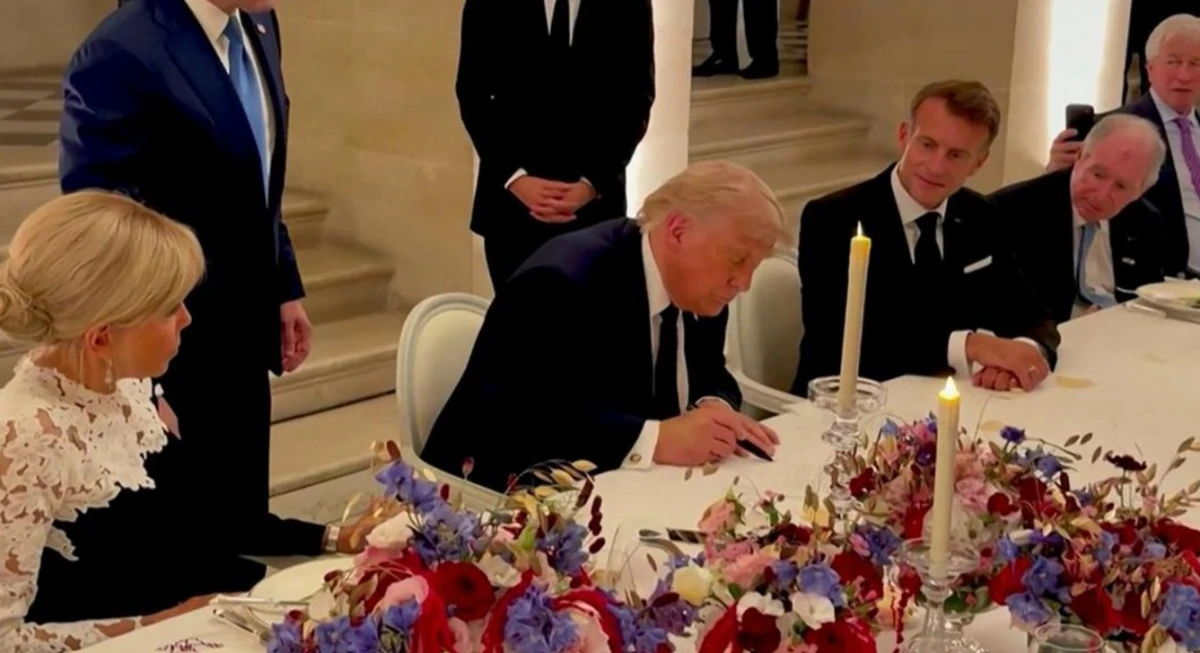
Trump signed the memorandum in June while he was in France, according to the same report.
The agreement was designed as an initial step that could open the way for final peace negotiations.
However, the diplomatic process later unraveled as tensions rose again and both sides accused each other of violating the terms.
As a result, the memorandum effectively lost its ability to contain the confrontation.
Pezeshkian’s comments in Bishkek therefore amounted to a proposal to revive an existing framework rather than create a new one from scratch.
Renewed attacks have raised tensions again
The appeal came after another round of military action between Washington and Tehran.
DW Türkçe reported that the U.S. military carried out strikes on Iran’s Lark Island on Sunday, marking renewed attacks after a break of about one month.
Iran subsequently launched attacks against U.S. military targets in Jordan and the United Arab Emirates, according to the report.
The exchange further weakened expectations that the earlier memorandum could automatically restore stability.
Pezeshkian nevertheless avoided presenting military confrontation as the only possible path forward.
His message in Bishkek was that Iran was still willing to react positively if the United States returned to the diplomatic framework.
That combination — retaliation on the one hand and an offer to resume commitments on the other — illustrates the two-track approach described by Iranian officials.
The immediate question is whether Washington sees the Islamabad Memorandum as a viable basis for renewed negotiations.
Araghchi also says Tehran is ready for talks
Pezeshkian’s statement followed a similar message from Iranian Foreign Minister Abbas Araghchi.
According to DW Türkçe, Araghchi said a day earlier that Iran was prepared to return to the negotiating table.
He also called on the United States to recommit to the Islamabad Memorandum.
Araghchi argued that Trump should stand by the agreement bearing his signature and suggested that doing so could restore the diplomatic process.
“If that happens, we will get back on the right track,” Araghchi said.
The foreign minister’s comments and Pezeshkian’s later remarks point to a coordinated message from Tehran.
Both officials are saying that Iran remains prepared for negotiations, but both have tied that willingness to renewed U.S. compliance with the earlier agreement.
The Iranian leadership is therefore not presenting talks as unconditional. Its stated condition is that Washington first return to the commitments Tehran says were abandoned.
Strait of Hormuz remains a central point of tension
The dispute also has implications beyond bilateral U.S.-Iran relations.
DW Türkçe reported that the two sides are engaged in a struggle for control in the strategically important Strait of Hormuz.
The waterway is critical to international trade and global energy supplies, making security developments in the area relevant far beyond the Middle East.
Military escalation in or around the Strait could affect shipping routes and increase concerns over the movement of energy supplies.
That broader strategic importance adds weight to efforts aimed at preventing further escalation.
The breakdown of the Islamabad Memorandum therefore has consequences not only for relations between Washington and Tehran but also for regional security and international commerce.
Pezeshkian’s proposal to revive the agreement comes at a time when military actions are once again increasing the risk of a wider confrontation.
Bishkek message puts focus back on diplomacy
Pezeshkian delivered his message while attending the Shanghai Cooperation Organisation summit in Bishkek, where leaders from several countries were gathered for high-level meetings.
Against that diplomatic backdrop, the Iranian president chose to publicly signal that an opening with Washington remained possible.
His position was straightforward: if Trump announces that the United States will again comply with the Islamabad Memorandum, Iran says it will immediately respond positively.
The statement does not by itself resolve the accusations exchanged between the two sides over previous violations, nor does it establish that negotiations will resume.
It does, however, place a specific diplomatic option back on the table.
Araghchi’s similar remarks a day earlier reinforce the impression that Tehran is deliberately sending the same message through multiple senior officials.
For now, the next development will depend on whether the Trump administration responds to Iran’s call and whether either side is willing to restore the commitments contained in the memorandum after the latest round of military strikes.
WiseNewsPress.com
What's Your Reaction?
 Like
0
Like
0
 Dislike
0
Dislike
0
 Love
0
Love
0
 Funny
0
Funny
0
 Wow
0
Wow
0
 Sad
0
Sad
0
 Angry
0
Angry
0

Ahmet Taş is a journalist, editor and Turkey Office Manager of the Wise News Press Media Group. He works across news, digital media and international publishing, focusing on accurate, responsible and accessible journalism. He contributes to the development of media projects that bring important political, social and global developments to a wider international audience.















Comments (0)