



Russia rejects Black Sea moratorium as Türkiye seeks new grain deal
Russia rejected a proposed Black Sea moratorium as Türkiye continues talks with Moscow and Kyiv on a new deal to secure grain exports and commercial shipping.


By Ahmet Taş | Wise News Press
ANKARA, TÜRKİYE — Russia has rejected a proposed moratorium on attacks in the Black Sea as Türkiye continues diplomatic efforts with Moscow and Kyiv to establish a new mechanism for safe grain exports and commercial navigation.
According to DW Türkçe, citing Russia’s Interfax news agency, Russian Deputy Foreign Minister Alexander Grushko argued that a moratorium on Black Sea military activity would not bring the sides closer to a peaceful settlement. Türkiye, meanwhile, says it is working with both Russia and Ukraine on a framework resembling the 2022 grain agreement amid growing risks to ports, export infrastructure and merchant vessels.
Russia rejects proposed Black Sea moratorium
Moscow has signaled that it does not support a proposal aimed at halting attacks in the strategically important Black Sea.
Interfax reported that Grushko criticized the idea of introducing a moratorium on military activity between Russia and Ukraine in the maritime region.
According to the report, the Russian deputy foreign minister said such moratoriums would move the parties further away from hopes for a peaceful resolution of the war.


The position represents a setback for diplomatic efforts led by Türkiye, which has sought to separate commercial shipping and grain exports from the escalating military confrontation.
The Black Sea remains one of the most important routes for agricultural exports from both Russia and Ukraine, while the continuation of attacks is increasing risks for ports, vessels and export terminals.
Ankara has argued that protecting navigation could reduce the economic and humanitarian consequences of the conflict even if a broader political settlement remains out of reach.


Russia and Ukraine target maritime and export infrastructure
DW Türkçe reported that attacks between Russia and Ukraine in the Black Sea have intensified, placing international grain trade under growing pressure.
Both sides have targeted export infrastructure, terminals and vessels involved in maritime transportation, according to the report.
Russian attacks have intensified particularly around the Ukrainian port city of Odesa in recent months.
Ukrainian President Volodymyr Zelensky said Russian guided aerial attacks and drone strikes had continued against Odesa and surrounding areas since the previous evening.
According to Zelensky, thousands of families were left without electricity, while a border crossing with Romania and export infrastructure were deliberately damaged.
The attacks have added pressure to ports that have historically played a central role in Ukraine’s international trade.
DW Türkçe noted that the continuing strikes have effectively restricted access to ports that once handled around 90 percent of Ukraine’s exports.
Damage to port and transport infrastructure has consequences beyond Ukraine because agricultural commodities shipped through the Black Sea supply markets in multiple regions.
Türkiye works on a new grain agreement
Türkiye has continued contacts with both Moscow and Kyiv in an effort to restore safer commercial navigation in the Black Sea.
Foreign Minister Hakan Fidan recently proposed a moratorium on military activities in the maritime region as part of Ankara’s diplomatic initiative.
Speaking in Istanbul, Fidan said Türkiye was continuing efforts to improve navigation security and was in contact with both parties.
He also confirmed that Ankara had prepared a proposal concerning grain exports.
“We have prepared a study. We are in contact with both sides,” Fidan said.
According to the Turkish foreign minister, the objective is to create a new mechanism that would allow Russian and Ukrainian grain products to reach global markets safely through the Black Sea.
Fidan said the discussions were aimed at establishing an arrangement similar to the 2022 Black Sea grain agreement.
Türkiye had played a central diplomatic role in that earlier initiative, which sought to maintain agricultural exports despite the war.
The renewed effort reflects Ankara’s view that a maritime arrangement may still be possible even while broader peace negotiations remain difficult.
Attacks on Turkish-linked ships raise concern in Ankara
Türkiye’s concerns extend beyond global food supplies.
DW Türkçe reported that Turkish vessels have also been caught in attacks in the Black Sea, increasing concern in Ankara about the safety of commercial shipping.
The expanding military confrontation has raised questions about whether merchant vessels can safely enter and leave ports and which routes can remain protected from military operations.
One goal of Türkiye’s moratorium proposal is to separate civilian maritime activity from the military conflict as far as possible.
Moscow’s rejection of the proposal, however, complicates efforts to establish such a security framework.
Fidan has also warned that the character of the Russia-Ukraine war is changing.
According to his assessment, the conflict is no longer merely a war of attrition but is increasingly becoming a war of destruction.
He argued that steps are needed to prevent the sides from causing greater damage to each other and to the wider Black Sea region.
The growing danger to commercial vessels gives Türkiye an additional incentive to continue talks with both governments.
Grain disruption poses risks to global food security
The Black Sea is a critical route for transporting agricultural products from Russia and Ukraine to international markets.
For that reason, attacks on ports, terminals, export infrastructure and grain-carrying vessels can have consequences well beyond the immediate conflict zone.
Countries dependent on imported grain can face supply disruptions and higher prices when Black Sea shipping is restricted.
Fidan linked Türkiye’s initiative directly to the issue of global food security, arguing that the war is preventing Russian and Ukrainian agricultural products from reaching world markets under stable conditions.
Ankara wants to recreate a system under which ships can transport grain through the Black Sea with reduced military risk.
Any new mechanism, however, would require more than simply designating commercial shipping routes.
Russia and Ukraine would also need to reach some form of understanding on the protection of ports, vessels and related export infrastructure.
Russia’s opposition to a moratorium demonstrates how difficult that diplomatic task remains.
Without agreement on limits to military activity, shipping companies and crews continue to face significant uncertainty.
Erdoğan-Putin talks may include Black Sea security
The issue is also expected to feature in high-level diplomacy surrounding the Shanghai Cooperation Organisation leaders’ summit in Bishkek.
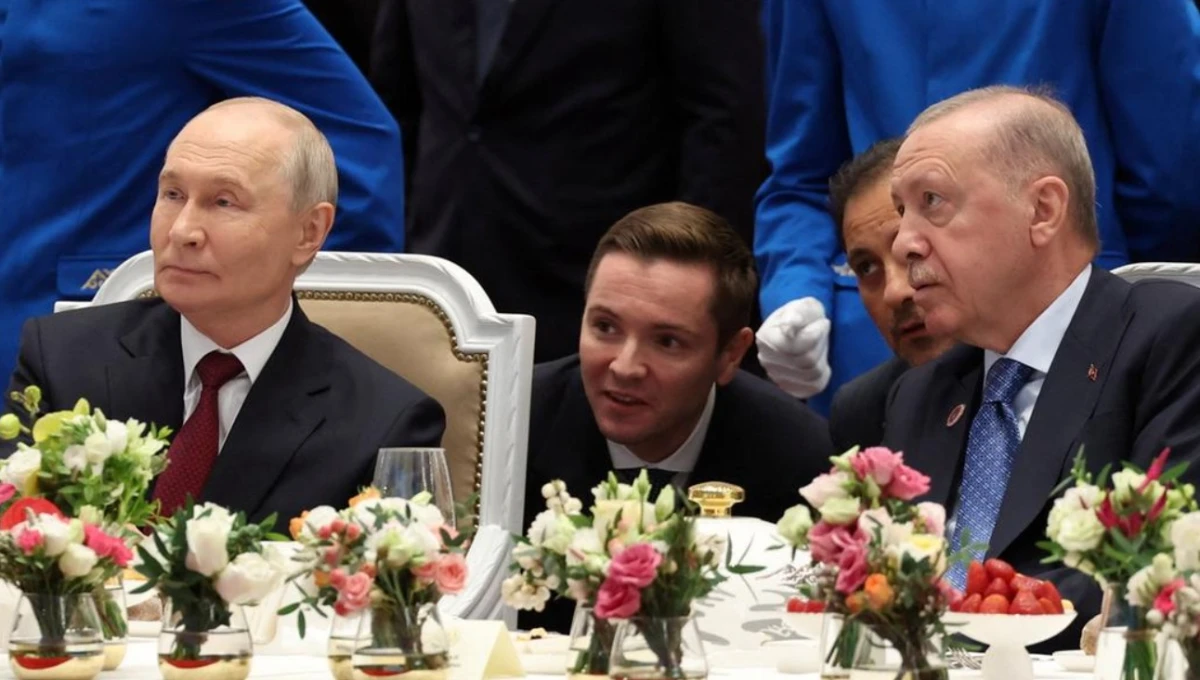
Turkish President Recep Tayyip Erdoğan and Russian President Vladimir Putin were photographed sitting together at an event held during the summit in the Kyrgyz capital.
According to DW Türkçe, Erdoğan was expected to raise the possibility of a new grain agreement and the broader issue of safe navigation in the Black Sea during a bilateral meeting with Putin.
Türkiye’s approach relies on maintaining dialogue with both Moscow and Kyiv rather than developing a mechanism involving only one side.
Ankara hopes that a framework acceptable to both governments could protect commercial navigation and restore more predictable grain exports.
A possible Erdoğan-Putin discussion in Bishkek could therefore become an important stage in determining whether Moscow is prepared to consider an alternative to the moratorium it has rejected.
The outcome would also help clarify whether negotiations can move beyond general proposals toward a workable maritime arrangement.
A new Black Sea compromise remains difficult
Russia’s rejection of the moratorium highlights the obstacles facing efforts to revive a protected grain corridor or similar maritime mechanism.
Türkiye continues to advocate safe navigation and the separation of commercial trade from military operations, while attacks on Black Sea infrastructure are intensifying.
The situation around Odesa illustrates the difficulty. Export infrastructure is being damaged at the same time diplomats are trying to create guarantees for international shipping.
For Ankara’s initiative to succeed, Moscow and Kyiv would need to accept at least a limited framework protecting commercial vessels, ports or designated routes from attack.
So far, Russia’s position suggests that agreement on a general moratorium is unlikely in the immediate term.
Türkiye nevertheless says diplomatic contacts are continuing.
Attention will now focus on Erdoğan’s contacts with Putin, Ankara’s discussions with Ukraine and whether the parties can find a narrower arrangement modeled on the 2022 grain agreement.
With Black Sea shipping increasingly exposed to the military conflict, the issue has become not only a regional security concern but also a question of international trade and global food supply.
WiseNewsPress.com
What's Your Reaction?
 Like
0
Like
0
 Dislike
0
Dislike
0
 Love
0
Love
0
 Funny
0
Funny
0
 Wow
0
Wow
0
 Sad
0
Sad
0
 Angry
0
Angry
0

Ahmet Taş is a journalist, editor and Turkey Office Manager of the Wise News Press Media Group. He works across news, digital media and international publishing, focusing on accurate, responsible and accessible journalism. He contributes to the development of media projects that bring important political, social and global developments to a wider international audience.















Comments (0)