



Iran Retaliates: U.S. Bases and Israel Struck in Massive Escalation
Following morning strikes by the U.S. and Israel, Tehran has launched a counter-offensive targeting regional military hubs and Israeli cities, paralyzing Middle Eastern aviation.



BY AHMET TAŞ | WISE NEWS PRESS
LONDON, UK — Iran launched a massive retaliatory strike against U.S. military installations and Israeli territory on Saturday afternoon, following a series of morning raids by Washington and Tel Aviv that have ignited a high-stakes regional conflict.
Explosions were reported near Al Udeid, the largest U.S. airbase in the Middle East located in Qatar, while the U.S. Navy’s 5th Fleet headquarters in Bahrain also came under direct missile fire. As the conflict expands, Israel has declared a "permanent state of emergency," and major airlines, including Turkish Airlines, have suspended all flights to the region until at least March 2, 2026. The rapid exchange of fire marks the most significant escalation in the Middle East in decades, threatening to destabilize global energy markets and the very foundations of regional governance.
Strategic U.S. Assets Under Fire in the Gulf
Tehran’s retaliation targeted the core of the American military presence in the Persian Gulf. In Qatar, residents reported thunderous explosions near the Al Udeid Air Base. While the Qatari Ministry of Defense stated that several attacks were successfully repelled, the proximity of the strikes to such a critical hub has sent shockwaves through the diplomatic community.
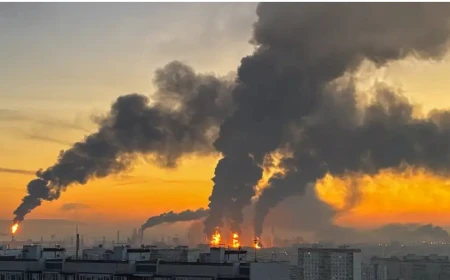
Simultaneously, thick plumes of black smoke were seen rising from the Juffair district in Bahrain, home to the U.S. Navy's 5th Fleet. The Bahraini state news agency confirmed that the fleet’s service center was hit by a missile. The 5th Fleet is responsible for naval operations across the Persian Gulf, Red Sea, and parts of the Indian Ocean, making it a primary strategic target for Iranian forces. In the United Arab Emirates, a civilian casualty was reported in Abu Dhabi due to falling debris from intercepted projectiles, while explosions were also heard near the U.S. Consulate in Erbil, Iraq, where security sources confirmed the interception of multiple rockets.
"The famous Palm Jumeirah in Dubai was not spared from the tension, as hotel guests captured footage of explosions illuminating the sky over the iconic island."


Israel Enters Permanent State of Emergency
Within Israel, the atmosphere turned from preemptive action to defensive survival. At approximately 08:15 local time, sirens began wailing across the country, prompting a nationwide rush to shelters. The Israeli military has officially declared a "special and permanent state of emergency," an unprecedented move reflecting the severity of the threat.
In the northern city of Tirat Carmel, civilians were evacuated after ammunition struck a residential building. Meanwhile, in Tel Aviv, thousands of citizens have taken refuge in underground metro stations to protect themselves from the ongoing missile waves. The Israeli Air Force (IAF) remains in the skies, actively engaging what they describe as multiple "threat clusters." By late afternoon, the military confirmed that Iran had launched a second wave of ballistic missiles, indicating that the retaliation is far from over.
Global Aviation Paralyzed by Airspace Closures
The violence has effectively severed one of the world's most vital aviation corridors. Most Gulf nations have canceled all incoming and outgoing flights as a safety precaution. Turkish Airlines (THY) issued a sweeping cancellation notice for all flights to Qatar, Kuwait, Bahrain, the UAE, and Oman for the remainder of the day.


Furthermore, THY announced that flights to Iran, Lebanon, Syria, Iraq, and Jordan are suspended until March 2, 2026. This logistical freeze has left thousands of passengers stranded and is expected to have a significant ripple effect on international trade and the movement of personnel in the energy sector.
The Nightmare Scenario: Fear of Total State Collapse
Regional leaders in Doha, Riyadh, and Abu Dhabi are watching the escalation with growing dread. While Qatar, the UAE, Kuwait, Bahrain, and Jordan have all reported intercepting Iranian missiles, their political calculus is focused on survival. For weeks, these leaders had worked to mediate between Washington and Tehran, hoping to avoid this exact scenario.
As noted by regional analysts, there is a profound fear that the Trump administration is prioritizing Israeli military advice over the concerns of its Arab allies. The primary anxieties for these neighboring states include:
-
Infrastructure Destruction: Attacks not just on military bases, but on the region's oil and gas infrastructure.
-
Maritime Chokepoints: The potential closure of the Strait of Hormuz, which would paralyze global oil exports.
-
Regime Collapse: The worst-case scenario involves the total collapse of the Iranian state, which would likely trigger a massive influx of refugees and an uncontrolled flow of weaponry into neighboring countries.
As the UN Security Council prepares for its midnight session, the question remains whether diplomacy can still find a foothold in a region where missiles are now the primary language of engagement.
What's Your Reaction?
 Like
0
Like
0
 Dislike
0
Dislike
0
 Love
0
Love
0
 Funny
0
Funny
0
 Wow
0
Wow
0
 Sad
0
Sad
0
 Angry
0
Angry
0

Editor | Wise News Press — Delivering accurate, timely global news with integrity, insight, and editorial responsibility.

















Comments (0)